
3D Printing Medical Devices Market Overview
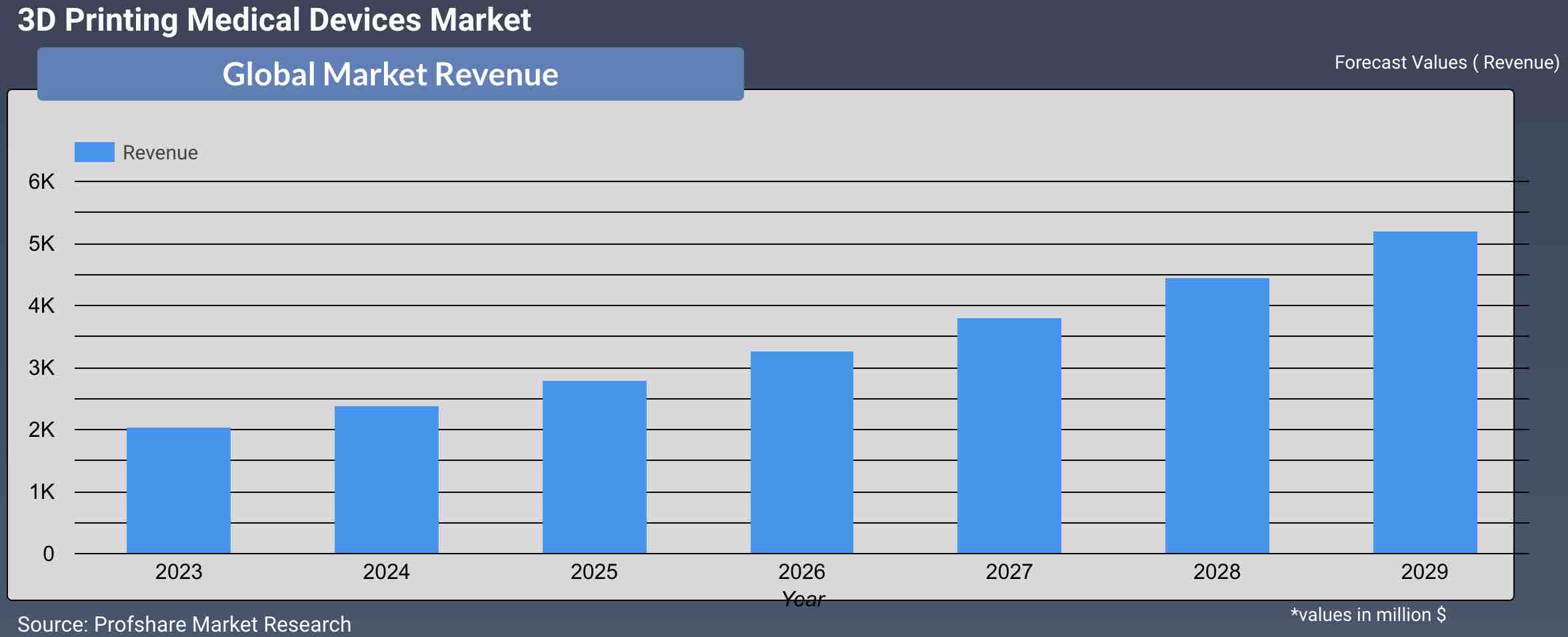
The 3D Printing Medical Devices Market was valued at USD 2.05 Billion in 2025 and is projected to reach USD 5.2 Billion by 2032, growing at a CAGR of 16.8% during 2026–2032, with North America holding the largest share.
Primary Drivers
- Rising demand for patient-specific implants and personalized medical devices is driving 3D printing adoption in healthcare manufacturing.
- Growing use of 3D printing for surgical planning models and prosthetics is expanding clinical applications.
- Increasing regulatory approvals for 3D-printed medical devices are boosting manufacturer and healthcare provider confidence in the technology.
Primary Challenges
- High costs of industrial-grade 3D printing equipment and biocompatible materials limit adoption among smaller healthcare facilities.
- Stringent regulatory approval processes for patient-specific printed devices increase development timelines and costs.
- Quality control and reproducibility challenges in 3D printing processes raise concerns about consistent product performance.
This report includes a dedicated chapter covering supply chain exposure, export controls, sanctions risk, and regulatory shifts affecting 3D Printing Medical Devices Market.
3D Printing Medical Devices Market Strategic Outlook
3D printing is an additive type of manufacturing process of a three-dimensional object created by building successive layers of raw material. Every layer is attached to one another until the object is fully completed. Objects are produced through a digital 3D file, such as a computer-aided design (CAD) drawing or a Magnetic Resonance Image (MRI).
Growth trajectory, 2026–2032
How this market is covered
Revenue split by type
Revenue by end use
No additional set-up of equipment or tools is required as 3D printing allows designers to make changes easily. The flexibility of 3D printing devices allows manufacturers to create devices matched to a patient’s anatomy (patient-specific devices) or even devices with very complex internal structures. These capabilities have created huge interest in the 3D printing of medical devices and other products, including food, household items, and automotive parts. Scientists are researching how to manufacture living organs such as a heart or liver using the 3D printing process.
3D Printing Medical Devices are broadly classified into two types: External Wearable Devices and Clinical Study Devices. External Wearable Devices are those 3-D printing devices that are ideally customized to fit each patient. In this process, 3-D printing is usually accompanied by 3-D scanning helping to create the geometry. These devices can be attached to the outside of a person. These devices are larger or thicker than those surgical devices or implants that have to reach into a body. This actually helps to overcome any mechanical strength issues with 3-D printing. Clinical Study Devices are created for clinical studies where build quantities are low and design changes after evaluation are likely. Clinical Study Devices have multiple plastic components whereas 3-D printing offers a cost-effective way to create clinically usable parts at low cost.
Geographically, the 3D Printing Medical Devices Market is segmented into several regions i.e. North America, Europe, Asia Pacific and Latin America, Middle East & Africa. North America held the largest share of the global 3D printing medical devices market in 2025, while Asia-Pacific is expected to witness the highest growth from 2026 and 2032. A number of efforts are made by leading market players in emerging Asian countries such as new 3D printing research, training, and education centres and expanding their distribution networks are contributing to the growth of the 3D printing medical devices market in this regional segment.
3D Printing Medical Devices Market: Product Type
- Materials
- System
- Services
3D Printing Medical Devices Market: Technology Type
- Photopolymerization
- Droplet Deposition
- Electronic Beam Melting (EBM)
- Laser Beam Melting
- Others
3D Printing Medical Devices Market: End Users
- Pharma Industry
- Hospitals
- Research Organizations
3D Printing Medical Devices Market: Application Analysis
- Implants
- External Wearable Devices
- Tissue Engineering
- Clinical Study Devices
3D Printing Medical Devices Market : Competitive Analysis
The report includes an accurate analysis of key players with Market Value, Company profile, and SWOT analysis. The Study consists of the following key players in the 3D Printing Medical Devices Market :
- 3D Systems
- 3T RPD
- Arcam
- Concept Laser
- EOS GmbH
- EnvisionTEC
- Materialise
- Prodways
- Renishaw
- Stratasys
Geographical analysis of 3D Printing Medical Devices Market:
-
North America
- U.S.A
- Canada
- Europe
- France
- Germany
- Spain
- UK
- Rest of Europe
- Asia Pacific
- China
- Japan
- India
- South East Asia
- Latin America
- Brazil
- Middle East and Africa
Surgical & Interventional Devices Landscape
Report Coverage
| Parameter | Details |
|---|---|
| Base Year | 2025 |
| Historical Data | 2020 – 2025 |
| Forecast Period | 2026 – 2032 |
| Base Year Value | USD 2.05 Billion |
| Forecast Value | USD 5.2 Billion |
| CAGR | 16.8% |
| Regional Scope | North America · Europe · Asia-Pacific · Latin America · MEA · RoW |
Frequently Asked Questions
3D Printing Medical Devices Market was valued at USD 2.05 Billion in 2025 and is estimated to reach USD 5.2 Billion by 2032.
3D Printing Medical Devices Market is projected to grow at a CAGR of 16.8% during 2025–2032.
3D Printing Medical Devices Market is dominated by the Implants segment and the North America region holds the highest market share in 2025.
Some of the top key players in the 3D Printing Medical Devices Market are 3D Systems,3T RPD,Arcam,Concept Laser,EOS GmbH,EnvisionTEC,Materialise,Prodways,Renishaw,Stratasys.
1. Rising demand for patient-specific implants and personalized medical devices is driving 3D printing adoption in healthcare manufacturing. 2. Growing use of 3D printing for surgical planning models and prosthetics is expanding clinical applications. 3. Increasing regulatory approvals for 3D-printed medical devices are boosting manufacturer and healthcare provider confidence in the technology.
Yes. The report includes a dedicated section on geopolitical risk factors and their impact on supply chains, pricing, and regional demand dynamics.