
Palm Oil Derivatives Market Overview
The Palm Oil Derivatives Market was valued at USD 17.42 Billion in 2025 and is projected to reach USD 28.15 Billion by 2032, growing at a CAGR of 7.1% during 2026–2032, with Asia-Pacific holding the largest share.
Primary Drivers
- Widespread use of palm oil derivatives in food processing, personal care, and industrial applications is sustaining broad-based demand across multiple end-use industries.
- Growing demand for palm-based oleochemicals in biodiesel and renewable energy applications is expanding market opportunities.
- Cost competitiveness of palm oil derivatives compared to alternative vegetable oil sources supports continued adoption by manufacturers.
Primary Challenges
- Growing environmental and deforestation concerns are driving stricter sustainability certification requirements and regulatory scrutiny.
- Volatility in crude palm oil prices, driven by weather and geopolitical factors, creates cost unpredictability for derivative manufacturers.
- Rising consumer and regulatory pressure toward palm oil-free labeling in some Western markets restrains demand growth in certain segments.
This report includes a dedicated chapter covering supply chain exposure, export controls, sanctions risk, and regulatory shifts affecting Palm Oil Derivatives Market.
Palm Oil Derivatives Market Strategic Outlook
Overview
Palm oil is an edible vegetable oil obtained from the pulp of the fruit of oil palm trees. It is naturally reddish in color due to its high beta-carotene content. Palm oil contains both saturated and unsaturated fats and is considered one of the most versatile vegetable oils used across food and non-food industries. Through chemical conversion processes, palm oil is transformed into several derivatives such as fatty acids, surfactants, glycerin, and emulsifiers, which are used extensively in detergents, cosmetics, pharmaceuticals, and industrial products.
The global Palm Oil Derivatives Market is witnessing steady growth due to expanding applications across food, biodiesel, cosmetics, pharmaceuticals, and industrial processing sectors. Increasing demand for bio-based and sustainable raw materials is further supporting long-term market expansion.
Palm oil is widely used for frying and cooking due to its high thermal stability and long shelf life. It is also an important ingredient in processed foods such as bakery products, non-dairy creamers, and vegetable ghee. In non-edible applications, palm oil derivatives are used in soaps, shampoos, conditioners, lubricants, and chemical intermediates.
Red palm oil is valued for its natural carotenoids and vitamin content and is used in skincare and nutritional products. The major varieties used for palm oil production include African palm oil and American palm oil, both of which contribute significantly to global production.
Growth trajectory, 2026–2032
How this market is covered
Revenue split by type
Product type & Competitive analysis
On the basis of the product type, the palm oil derivatives are spilt into three grades: food grade, cosmetic grade and industrial grade. Food products use different fractions and derivatives of palm oil. Palm oil in food is very healthy for the health of the person as it prevent cancer, brain disease, malaria etc. Palm oil not contain in food grade only but it also contain in cosmetics, which help prevent disease. Palm oil is also used in cosmetics, the cosmetics which is used for face, hair, and body also contains the palm oil. There is strong scope of palm oil in the food and beverages industry. The palm oil are used in various grade of the industries. Textile industry owing to emulsifying softeners, scouring agents, wetting agents and dispersants properties should fuel product demand.
Application & Regional analysis
On the basis of application, palm oil derivatives are deeply used in food, biodiesel, cosmetics and personal care. Edible oil is one of the dominant application scopes which is raising globally. Palm oil derivatives are used personal care products such as hair spray, shampoo and conditioners. Palm oil derivatives increase in personal care and cosmetics industry is likely to drive the fatty acid market size growth. The raising usage of biodiesel in power and fuel generation application may propel biodiesel demand. Raising energy needs have shifted customer preference from gasoline to bio-based fuel. Strong governmental regulations have encouraged bio-based lubricants and surfactants consumption.
On the basis of geographical analysis, palm oil derivatives are divided into several regions which are as follows: China, Japan, South Korea, Taiwan, India, Southeast Asia, and Australia. The Asia Pacific, operated by India, Japan, Malaysia and China palm oil derivatives market size may witness significant acquire owing to rise in animal feed and cosmetic and personal care industry. Malaysia is the largest exporter and India is the largest importer. The free trade agreement between Malaysia and other countries for import and export business will drive regional industry growth. Firms are focusing toward product development along with advancement in technological will drive regional growth.
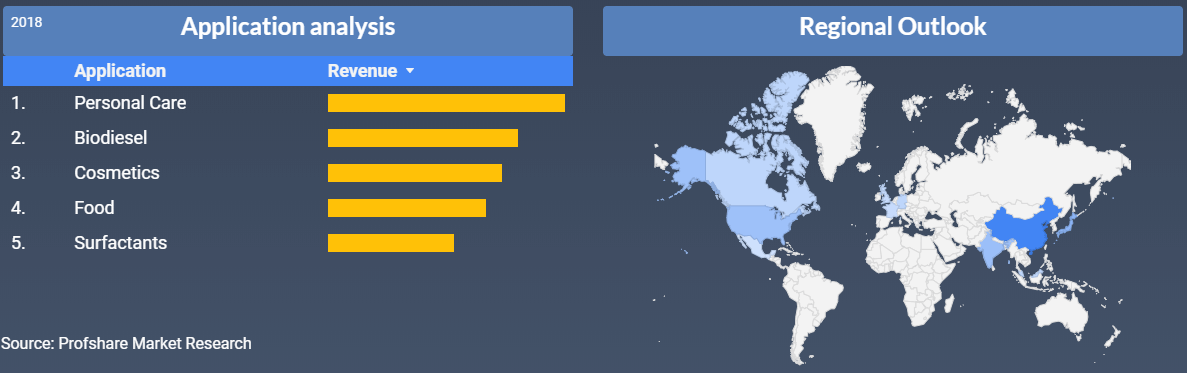
Palm Oil Derivatives Market: Product Type
- Food Grade
- Cosmetic Grade
- Industrial Grade
Palm Oil Derivatives Market: Application
- Food
- Biodiesel
- Cosmetics
- Personal Care
- Surfactants
Palm Oil Derivatives Market: Competitive Analysis
Report includes accurate analysis of key players with Market Value, Company profile, SWOT analysis. The Study consists of following key players in Palm Oil Derivatives Market:
- Croda
- Kubota Corporation
- Felda Holdings
- Sarawak Energy
- Veolia
- The Clorox Company
- Cargill
- Alami Group
- Wilmar International
- London Sumatra
Geographical analysis of Palm Oil Derivatives Market:
-
North America
- U.S.A
- Canada
- Europe
- France
- Germany
- Spain
- UK
- Rest of Europe
- Asia Pacific
- China
- Japan
- India
- South East Asia
- Latin America
- Brazil
- Middle East and Africa
Ingredients, Additives & Functional Components Landscape
Report Coverage
| Parameter | Details |
|---|---|
| Base Year | 2025 |
| Historical Data | 2020 – 2025 |
| Forecast Period | 2026 – 2032 |
| Base Year Value | USD 17.42 Billion |
| Forecast Value | USD 28.15 Billion |
| CAGR | 7.1% |
| Regional Scope | North America · Europe · Asia-Pacific · Latin America · MEA · RoW |
Frequently Asked Questions
Palm Oil Derivatives Market was valued at USD 17.42 Billion in 2025 and is estimated to reach USD 28.15 Billion by 2032.
Palm Oil Derivatives Market is projected to grow at a CAGR of 7.1% during 2025–2032.
Palm Oil Derivatives Market is dominated by the Cosmetics segment and the Asia-Pacific region holds the highest market share in 2025.
Some of the top key players in the Palm Oil Derivatives Market are Croda, Kubota Corporation, Felda Holdings,Sarawak Energy, Veolia, The Clorox Company, Cargill, Alami Group, Wilmar International, London Sumatra.
1. Widespread use of palm oil derivatives in food processing, personal care, and industrial applications is sustaining broad-based demand across multiple end-use industries. 2. Growing demand for palm-based oleochemicals in biodiesel and renewable energy applications is expanding market opportunities. 3. Cost competitiveness of palm oil derivatives compared to alternative vegetable oil sources supports continued adoption by manufacturers.
Yes. The report includes a dedicated section on geopolitical risk factors and their impact on supply chains, pricing, and regional demand dynamics.