
This report includes a dedicated chapter covering supply chain exposure, export controls, sanctions risk, and regulatory shifts affecting Electric Vehicles (EVs) Market.
Electric Vehicles (EVs) Market Strategic Outlook
Overview
The Electric Vehicles (EVs) Market is rapidly transforming the global automotive landscape as governments, automakers, and energy stakeholders accelerate the transition toward electrified mobility. Electric vehicles utilize battery-powered propulsion systems supported by high-capacity lithium-ion battery packs, electric motors, power electronics, and advanced energy management software to deliver zero or low tailpipe emissions while improving drivetrain efficiency. EV architectures are increasingly designed around dedicated skateboard platforms that integrate battery packs into the vehicle floor, enabling improved weight distribution, modular vehicle design, and enhanced driving range.
The market is expanding as regulatory frameworks targeting carbon neutrality, advancements in battery technology, and growing investments in charging infrastructure collectively strengthen the EV ecosystem. Automakers are strategically transitioning their product portfolios toward battery electric vehicles while scaling production of electrified platforms supported by global battery supply chains and gigafactory investments. As charging networks expand and battery costs continue to decline, electric vehicles are emerging as a central pillar of the next-generation sustainable transportation ecosystem.
Market Forecast 2026–2032
⬇ Download Chart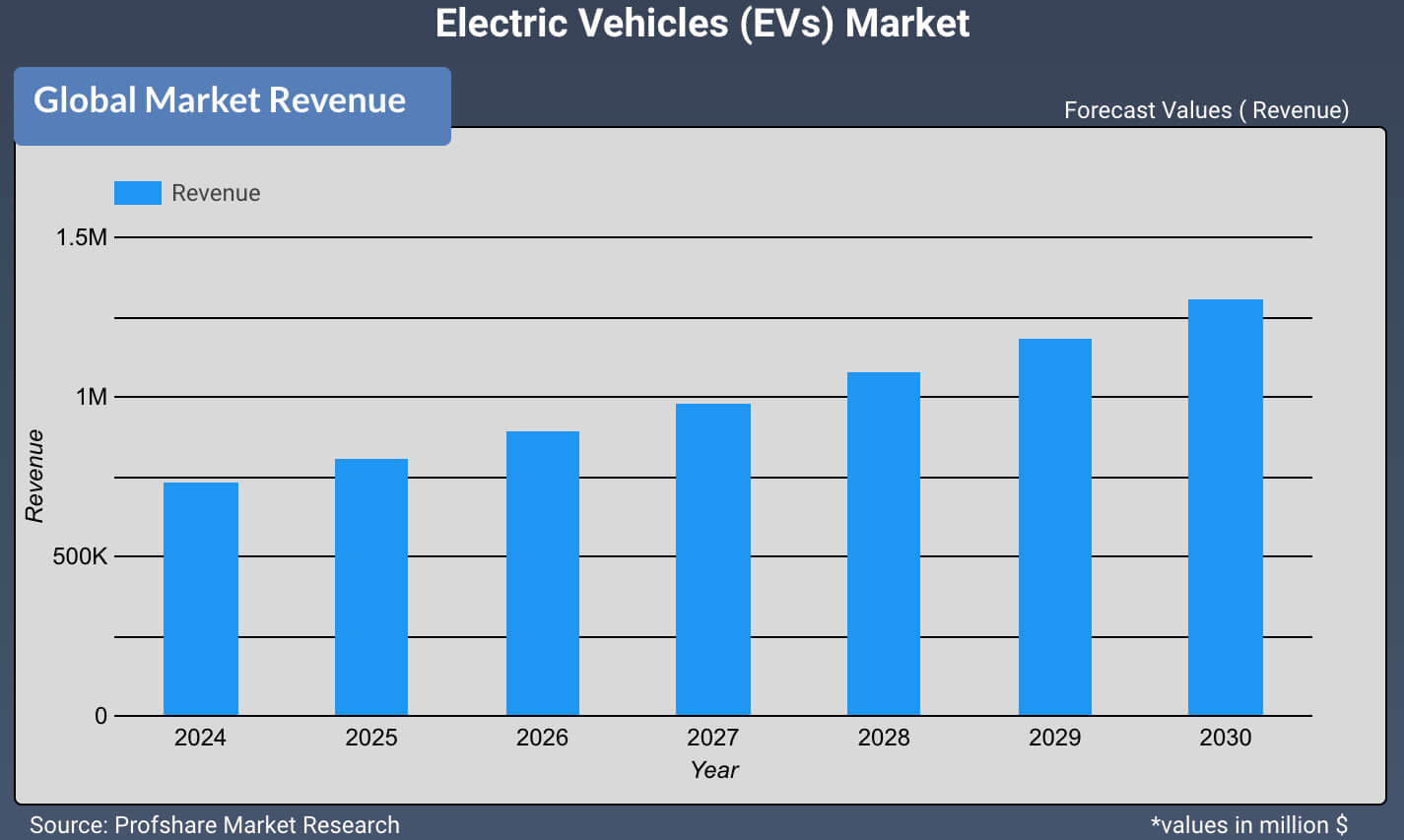
Market Drivers
Stringent environmental regulations and global carbon reduction commitments are among the primary drivers of the Electric Vehicles (EVs) Market. Governments across major economies are introducing emission standards, zero-emission vehicle mandates, and financial incentives that encourage both consumers and manufacturers to adopt electric mobility solutions.
Declining battery costs and improvements in lithium-ion battery performance are significantly enhancing EV affordability and practicality. Advances in energy density, fast charging capability, and battery lifecycle management are enabling longer driving ranges while reducing total cost of ownership for electric vehicles.
Automotive manufacturers are also investing heavily in electrified vehicle platforms and dedicated EV architectures. These investments support scalable vehicle production, improved powertrain efficiency, and integration of advanced vehicle software systems that enhance overall performance and connectivity.
Emerging Trends
Battery innovation remains one of the most influential trends shaping the EV market. Research and development in solid-state batteries, lithium iron phosphate chemistries, and battery recycling technologies are expected to significantly improve energy density, safety, and sustainability of electric vehicle power systems.
Another key trend is the expansion of high-power charging infrastructure. Ultra-fast DC charging networks capable of delivering 150 kW to 350 kW charging speeds are being deployed globally to reduce charging times and enable long-distance EV travel.
Software-defined vehicle architectures are also transforming EV platforms. Over-the-air software updates, intelligent battery management systems, and advanced vehicle connectivity features are enabling continuous performance optimization and improved user experience.
Segment Insights
By vehicle type, the Electric Vehicles (EVs) Market includes battery electric vehicles (BEVs), plug-in hybrid electric vehicles (PHEVs), and hybrid electric vehicles (HEVs). Battery electric vehicles represent the fastest-growing segment due to increasing regulatory support and the elimination of internal combustion engine components.
By vehicle category, the market includes passenger vehicles, light commercial vehicles, and heavy commercial vehicles. Passenger EVs account for the largest market share as global automakers expand their consumer EV portfolios and governments incentivize personal electric vehicle adoption.
By battery chemistry, lithium-ion batteries dominate the market due to their high energy density and scalability. However, emerging battery technologies are expected to reshape future vehicle performance and charging capabilities.
Regional Insights
Asia Pacific dominates the Electric Vehicles (EVs) Market, driven by strong policy support, large-scale EV manufacturing, and a well-established battery supply chain ecosystem. China remains the largest EV market globally due to government incentives, aggressive electrification policies, and rapid expansion of domestic EV manufacturers.
Europe represents one of the fastest-growing EV markets supported by strict emission regulations and aggressive decarbonization targets. Countries such as Norway, Germany, and the Netherlands have witnessed significant EV adoption due to supportive policies and developed charging infrastructure.
North America is experiencing strong EV market growth as major automakers invest in electrified vehicle production and governments expand funding for charging infrastructure development.
Competitive Landscape
The Electric Vehicles (EVs) Market is highly competitive with global automotive manufacturers accelerating electrification strategies to maintain market share. Companies are investing in dedicated EV platforms, battery manufacturing facilities, and software-driven vehicle architectures to strengthen their competitive positioning.
Strategic partnerships between automakers, battery manufacturers, and energy companies are enabling the development of integrated electric mobility ecosystems that include vehicle production, battery supply chains, and charging infrastructure deployment.
Key companies operating in the EV market include Tesla Inc., BYD Company Ltd., Volkswagen AG, General Motors Company, Hyundai Motor Group, and Toyota Motor Corporation. These companies continue to expand EV product portfolios and invest in next-generation battery and powertrain technologies.
The report provides comprehensive analysis and forecasts for the Electric Vehicles (EVs) Market at global and regional levels, evaluating regulatory developments, technological innovations, and infrastructure expansion shaping market growth.
The study further includes value chain analysis, battery supply chain insights, and strategic developments such as product launches, partnerships, and investments in EV manufacturing and charging infrastructure. These insights help stakeholders understand the evolving electric mobility ecosystem and identify long-term growth opportunities.
Electric Vehicles (EVs) Market: Product Type
- Hybrid Electric Vehicle (HEV)
- Battery Electric Vehicle (BEV)
- Plugin Hybrid Electric Vehicle (PHEV)
Electric Vehicles (EVs) Market : Application
- Passenger Cars
- Buses
- Commercial Vehicles
Global Electric Vehicles (EVs) Market: Competitive Analysis
Report includes accurate analysis of key players with Market Value, Company profile, SWOT analysis. The Study consists of following key players in Global Electric Vehicles (EVs) Market:
- Tesla Inc
- Honda Motor Co., Ltd
- Nissan Motor Corporation
- Ford Motor Company
- Toyota Motor Corporation
- Bayerische Motoren Werke AG
- General Motors
- Volkswagen
- Groupe Renault
- Daimler AG
Geographical analysis of Electric Vehicles (EVs) Market:
-
North America
- U.S.A
- Canada
- Europe
- France
- Germany
- Spain
- UK
- Rest of Europe
- Asia Pacific
- China
- Japan
- India
- South East Asia
- Latin America
- Brazil
- Middle East and Africa
Electric Mobility and Future Vehicle Platform Landscape
Report Coverage
| Parameter | Details |
|---|---|
| Base Year | 2025 |
| Historical Data | 2020 – 2025 |
| Forecast Period | 2026 – 2032 |
| Base Year Value | USD 670.24 Billion |
| Forecast Value | USD 1,306.1 Billion |
| CAGR | 10% |
| Regional Scope | North America · Europe · Asia-Pacific · Latin America · MEA · RoW |
Frequently Asked Questions
Electric Vehicles (EVs) Market was valued at USD 670.24 Billion in 2025 and is estimated to reach USD 1,306.1 Billion by 2032.
Electric Vehicles (EVs) Market is projected to grow at a CAGR of 10% during 2025–2032.
Electric Vehicles (EVs) Market is dominated by the Hybrid Electric Vehicle (HEV) segment and the Asia-Pacific region holds the highest market share in 2025.
Some of the top key players in the Electric Vehicles (EVs) Market are Tesla Inc, Honda Motor Co., Ltd, Nissan Motor Corporation, Ford Motor Company, Toyota Motor Corporation, Bayerische Motoren Werke AG, General Motors, Volkswagen, Groupe Renault, Daimler AG.
Primary driving factors for the growth of the Electric Vehicles (EVs) Market include Rising population, government initiative and technological advancement.
Yes. The report includes a dedicated section on geopolitical risk factors and their impact on supply chains, pricing, and regional demand dynamics.