

Battery Separators Market Overview
The Battery Separators Market was valued at USD 7.68 Billion in 2025 and is projected to reach USD 21.85 Billion by 2032, growing at a CAGR of 16.1% during 2026–2032, with Asia-Pacific holding the largest share.
Primary Drivers
- Surging EV and hybrid vehicle production is driving demand for high-performance lithium-ion battery separators.
- Growing use of lithium-ion batteries in renewable energy storage is displacing lead-acid batteries across grid and industrial applications.
- Expansion of consumer electronics and industrial/data-center energy storage systems is sustaining demand for compact, safety-rated separator materials.
Primary Challenges
- Safety and handling risks, including overheating and thermal-runaway incidents, are prompting stricter regulatory scrutiny of battery components.
- Maintaining consistent material quality and uniformity across separator production remains a persistent manufacturing hurdle.
- Insufficient government support and underdeveloped charging/storage infrastructure in emerging economies constrain broader market penetration.
Built for Strategic Decision-Makers
Strategy & Corporate Development
Market entry evaluation, portfolio expansion, and growth mandate analysis in the Battery Separators market.
Investors & M&A Teams
Competitive due diligence, target screening, and sector risk assessment across Battery Separators companies.
Go-to-Market Teams
Pricing benchmarking, segment prioritization, and Battery Separators demand forecasting.
This report includes a dedicated chapter covering supply chain exposure, export controls, sanctions risk, and regulatory shifts affecting Battery Separators Market.
Battery Separators Market Strategic Outlook
Growth trajectory, 2026–2032
How this market is covered
Revenue split by type
Revenue by end use
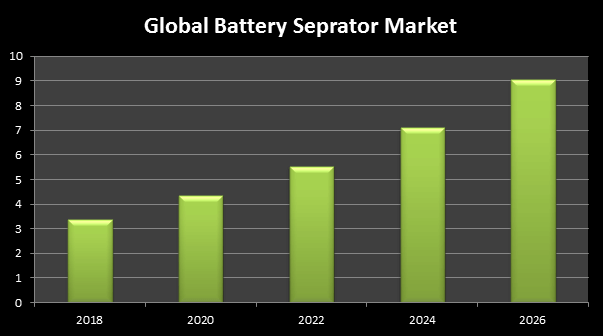
Battery Separators market was valued at USD 2.65 billion in 2025 and is expected to reach USD 9.07 billion by 2026, at a CAGR of 13.1 % from 2016 to 2026.Battery Separators play a primary role in all batteries. The main function of the battery separator is to keep the positive and negative electrodes apart to prevent electrical short circuits. It also allows the fast transfer of the ionic charge carriers that are needed to complete the circuit for the passage of the current in an electro chemical cell.
Battery Separators market is segmented into Lead Acid and Li-ion Battery separator based on the product type. Lead Acid battery have very low energy to weight ratio. It has ability to supply high surge currents. These batteries are low in cost which makes them attractive for use in motor vehicles to provide high current used in automobile motors. Large size lead batteries are used in cell phone towers, hospitals, and power systems.
A lithium-ion battery or Li-ion battery is a type of rechargeable battery in which lithium ions move from the negative electrode to the positive electrode during discharge and back when charging. Among the end-user applicants, it is commonly used in home electronics. They are one of the most popular types of rechargeable batteries for portable electronics, with a high energy density, tiny memory effect and low self-discharge. They are also growing in popularity for military, battery electric vehicle and aerospace applications.
Fastest growing market for battery separators is accounted by Asia Pacific. China is estimated to be the fastest-growing market for battery separators in the Asia Pacific region. China is forcasted to be the hub for production of the automobile sector. Factors for rising the demand for Battery in the market is present infrastructure developments, industrialization activities, opportunities.Major players in the global battery separator market are Toray Industry (Japan), Asahi Kasei (Japan), SK Innovation (South Korea), Freudenberg (Germany), Entek International (US), W-Scope Industries (Japan), Ube Industries (Japan), Sumitomo Chemical (Japan), Dreamweaver International (US), Bernard Dumas (France).
Battery Separators Market: Product Type
- Lead Acid
- Li-ion
Battery Separators Market: End Users/Application Analysis
- Automotive
- Consumer Electronics
- Industrial
Battery Separators Market : Competitive Analysis
Global Battery Separators market competition by top manufacturers/players, with Battery Separators sales volume, Price (USD/MT), revenue (Million USD) and market share for each manufacturer/player; the top players includes:
- Toray Industry (Japan)
- Asahi Kasei (Japan)
- SK Innovation (South Korea)
- Freudenberg (Germany)
- Entek International (US)
- W-Scope Industries (Japan)
- Ube Industries (Japan)
- Sumitomo Chemical (Japan)
- Dreamweaver International (US)
- Bernard Dumas (France)
Geographical analysis of Battery Separators Market:
-
North America
- U.S.A
- Canada
- Europe
- France
- Germany
- Spain
- UK
- Rest of Europe
- Asia Pacific
- China
- Japan
- India
- South East Asia
- Latin America
- Brazil
- Middle East and Africa
Battery Separators Market Report
Polymers and Resins Landscape
Report Coverage
| Parameter | Details |
|---|---|
| Base Year | 2025 |
| Historical Data | 2020 – 2025 |
| Forecast Period | 2026 – 2032 |
| Base Year Value | USD 7.68 Billion |
| Forecast Value | USD 21.85 Billion |
| CAGR | 16.1% |
| Regional Scope | North America · Europe · Asia-Pacific · Latin America · MEA · RoW |
Frequently Asked Questions
Battery Separators Market was valued at USD 7.68 Billion in 2025 and is estimated to reach USD 21.85 Billion by 2032.
Battery Separators Market is projected to grow at a CAGR of 16.1% during 2025–2032.
1. Surging EV and hybrid vehicle production is driving demand for high-performance lithium-ion battery separators. 2. Growing use of lithium-ion batteries in renewable energy storage is displacing lead-acid batteries across grid and industrial applications. 3. Expansion of consumer electronics and industrial/data-center energy storage systems is sustaining demand for compact, safety-rated separator materials.
Yes. The report includes a dedicated section on geopolitical risk factors and their impact on supply chains, pricing, and regional demand dynamics.