
This report includes a dedicated chapter covering supply chain exposure, export controls, sanctions risk, and regulatory shifts affecting Automotive Powertrain Control Module Market.
Automotive Powertrain Control Module Market Strategic Outlook
Overview
Powertrain Control Module (PCM) is a critical automotive electronic component responsible for managing and coordinating various sub-systems within a vehicle’s powertrain architecture. It acts as a central processing unit that integrates engine control and transmission management functions to ensure optimal vehicle performance, fuel efficiency, and emission compliance.
A powertrain control module typically combines the functionalities of the engine control module (ECM) and transmission control module (TCM). The ECM regulates engine parameters such as fuel injection, ignition timing, and air–fuel mixture, while the transmission control module processes engine data to manage gear shifting and drivetrain efficiency. Together, these systems enable smooth vehicle operation, reduced emissions, and improved fuel economy.
Modern PCM systems also manage additional functions including emission control, automatic transmission coordination, fuel management, and interaction with braking and safety systems. As vehicles become more software-driven and electronically integrated, the importance of powertrain control modules continues to increase across both conventional and electrified vehicle platforms.
Market Forecast 2026–2032
⬇ Download Chart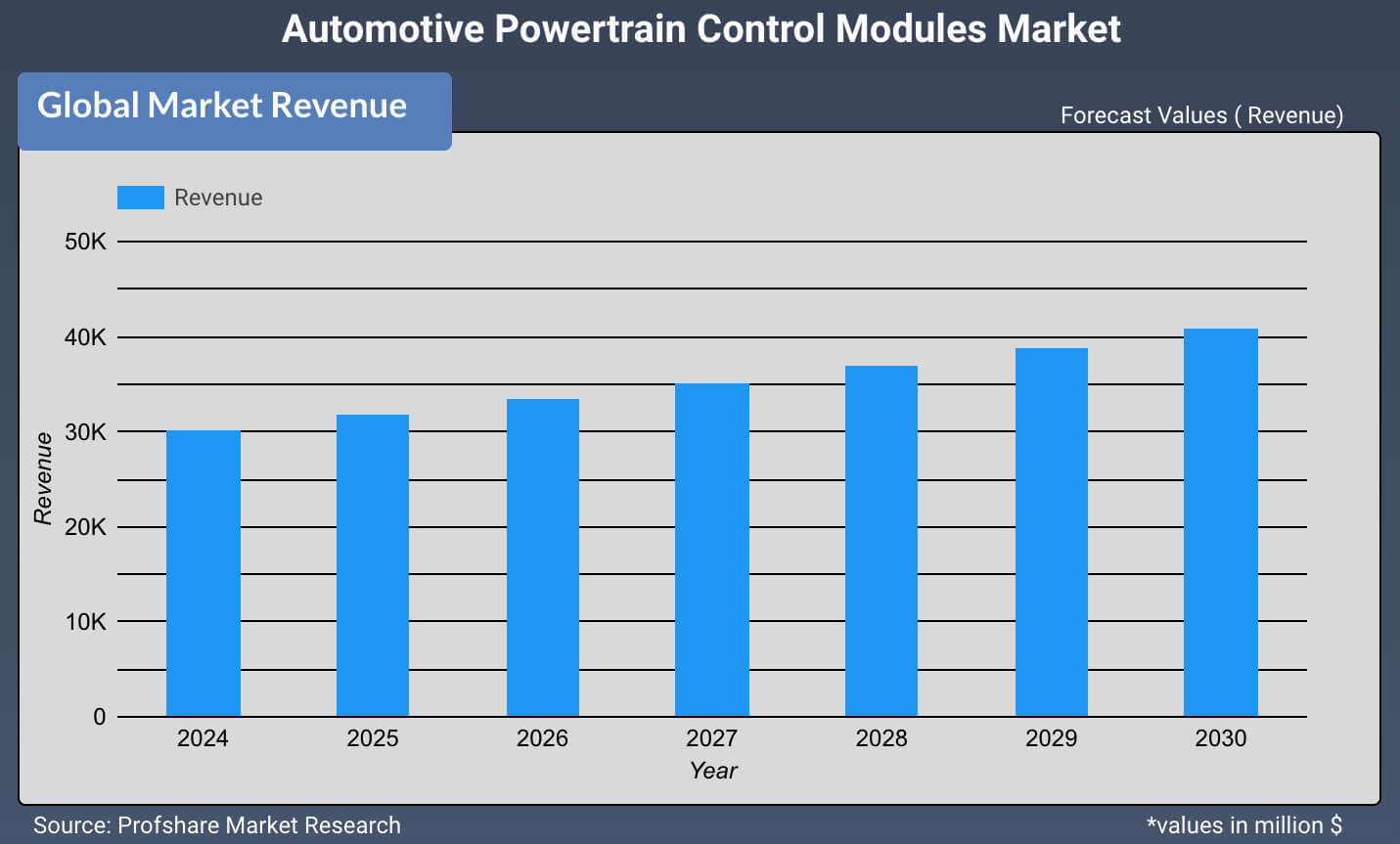
Market Drivers
The automotive powertrain control module market is primarily driven by rising demand for fuel-efficient vehicles and increasing adoption of automatic transmission systems worldwide. Consumers are increasingly prioritizing driving comfort, smoother gear transitions, and reduced operational complexity, which is accelerating the integration of advanced PCM technologies in modern vehicles.
Stringent government regulations related to emission reduction and fuel economy are further contributing to the growth of PCM deployment. Automakers are investing in advanced control modules capable of optimizing engine performance while minimizing environmental impact. The growth of hybrid and electric vehicles is also expanding the role of powertrain control systems in managing energy flow and drivetrain efficiency.
Additionally, the integration of advanced diagnostics and real-time monitoring capabilities into powertrain control modules is enabling predictive maintenance and improved vehicle reliability, which is encouraging OEM adoption.
Emerging Trends
The transition toward software-defined vehicles is reshaping powertrain control architectures. Manufacturers are increasingly adopting advanced microcontrollers, high-performance processors, and AI-enabled control algorithms to improve responsiveness and optimize performance. Over-the-air (OTA) software updates are also emerging as a key feature, enabling automakers to enhance powertrain functionality remotely.
Electrification is another major trend influencing PCM development. Hybrid and electric powertrains require intelligent control systems capable of managing battery performance, regenerative braking, and energy distribution. This is driving demand for next-generation control modules with enhanced processing capabilities and integration flexibility.
The development of lightweight and compact modules is also gaining traction as automakers seek to reduce vehicle weight and improve overall efficiency. Integration with vehicle-wide electronic architecture and connected mobility platforms is further shaping product innovation.
Segment Insights
By vehicle type, the powertrain control module market is segmented into passenger cars and commercial vehicles. Passenger cars represent the largest share due to higher production volumes and increasing adoption of automatic transmissions, advanced fuel management systems, and performance optimization technologies.
Commercial vehicles are also witnessing rising demand for advanced powertrain control solutions to improve fuel economy, operational efficiency, and compliance with emission standards. Fleet operators are increasingly adopting vehicles equipped with intelligent control systems to optimize performance and reduce maintenance costs.
By technology, the market includes modules designed for conventional internal combustion engines, hybrid powertrains, and electric vehicles. Electrified powertrain control modules are expected to experience significant growth as global vehicle electrification accelerates.
Regional Insights
Asia Pacific is projected to dominate the automotive powertrain control module market due to strong automotive production in countries such as China, India, Japan, and South Korea. Rising disposable income, growing vehicle ownership, and increasing adoption of advanced automotive technologies are supporting regional demand.
North America represents a significant market driven by high demand for automatic transmission vehicles, strong regulatory focus on emission control, and rapid adoption of connected vehicle technologies. The presence of major OEMs and technology providers further strengthens regional market growth.
Europe also holds a considerable share of the market due to stringent emission norms, innovation in automotive engineering, and increasing deployment of hybrid and electric vehicles across the region.
Competitive Landscape
The automotive powertrain control module market is characterized by strong competition among global automotive electronics suppliers and Tier-1 manufacturers. Companies are focusing on developing high-performance control modules that support electrified drivetrains, advanced diagnostics, and integrated vehicle control systems.
Investments in research and development, strategic partnerships with OEMs, and advancements in semiconductor technologies are shaping competitive strategies. Manufacturers are also emphasizing modular designs, cost optimization, and scalability to support diverse vehicle platforms.
The growing shift toward autonomous and connected mobility is further encouraging companies to innovate in software-driven powertrain control solutions, enhancing system responsiveness and operational efficiency.
The study covers a detailed analysis, growth, and forecast of the Automotive Powertrain Control Module Market. The report includes market analysis on global and regional levels. The study covers historical data analysis from 2020 to 2025 and market forecast from 2026 to 2032 based on revenue generated. The study includes market value in terms of revenue in USD million for the period 2018–2030 and compound annual growth rate (CAGR) projections for 2026–2032. The market is expected to witness steady growth during the forecast period.
Global Automotive Powertrain Control Module Market: Product Type
- Electronic Control Module
- Transmission Control Module
Global Automotive Powertrain Control Module Market: Application
- Passenger Vehicle
- Commercial Vehicle
Global Automotive Powertrain Control Module Market: Competitive Analysis
Report includes accurate analysis of key players with Market Value, Company profile, SWOT analysis. The Study consists of following key players in Global Automotive Powertrain Control Module Market:
- Robert Bosch
- Continental
- ZF Friedrichshafen
- Denso
- Magneti Marelli
- Honda
- Delphi Automotive
- Ricardo
- Magna Powertrain
- Hitachi Automotive System
- Mitsubishi Electric
- Genral Motors (AC Delco)
- Eaton Corp
- FTP Industrial
- AVL Engineering Company
- Fijitsu
- Hyundai KEFICO
- Visteon
- Borg Warner
Geographical analysis of Global Automotive Powertrain Control Module Market:
-
North America
- U.S.A.
- Canada
- Europe
- France
- Germany
- Spain
- UK
- Rest of Europe
- Asia Pacific
- China
- Japan
- India
- South East Asia
- Latin America
- Brazil
- Middle East and Africa
Electric Mobility and Future Vehicle Platform Landscape
Report Coverage
| Parameter | Details |
|---|---|
| Base Year | 2025 |
| Historical Data | 2020 – 2025 |
| Forecast Period | 2026 – 2032 |
| Base Year Value | USD 28.84 Billion |
| Forecast Value | USD 40.85 Billion |
| CAGR | 5.1% |
| Regional Scope | North America · Europe · Asia-Pacific · Latin America · MEA · RoW |
Frequently Asked Questions
Automotive Powertrain Control Module Market was valued at USD 28.84 Billion in 2025 and is estimated to reach USD 40.85 Billion by 2032.
Automotive Powertrain Control Module Market is projected to grow at a CAGR of 5.1% during 2025–2032.
Automotive Powertrain Control Module Market is dominated by the Electronic Control Module segment and the North America region holds the highest market share in 2025.
Some of the top key players in the Automotive Powertrain Control Module Market are Bosch, Continental, Denso, Delphi Technologies, Hitachi Astemo, Valeo, Mitsubishi Electric, Magneti Marelli.
Primary driving factors for the growth of the Automotive Powertrain Control Modules Market include Rise in demand for automatic transmission across the globe due to its advantages such as fuel efficiency, less carbon emission, and driving comfort.
Yes. The report includes a dedicated section on geopolitical risk factors and their impact on supply chains, pricing, and regional demand dynamics.