
This report includes a dedicated chapter covering supply chain exposure, export controls, sanctions risk, and regulatory shifts affecting Adipic Acid Market .
Adipic Acid Market Strategic Outlook
Adipic Acid also known as Hexanedioic acid is very important industrial compound used in various applications. In 2025 Global market of Adipic Acid Market is approximately valued at USD 7916.64 million & estimated to show CAGR of 5.1 % between 2026 and 2032. Expected CAGR is comparatively less than almost 1.2 % that of between 2019 to 2023. Market has seen small drop in growth percentage primarily due to increasing environmental concerns & majority of governments are tightening pollution laws around the globe.
Market Forecast 2026–2032
⬇ Download Chart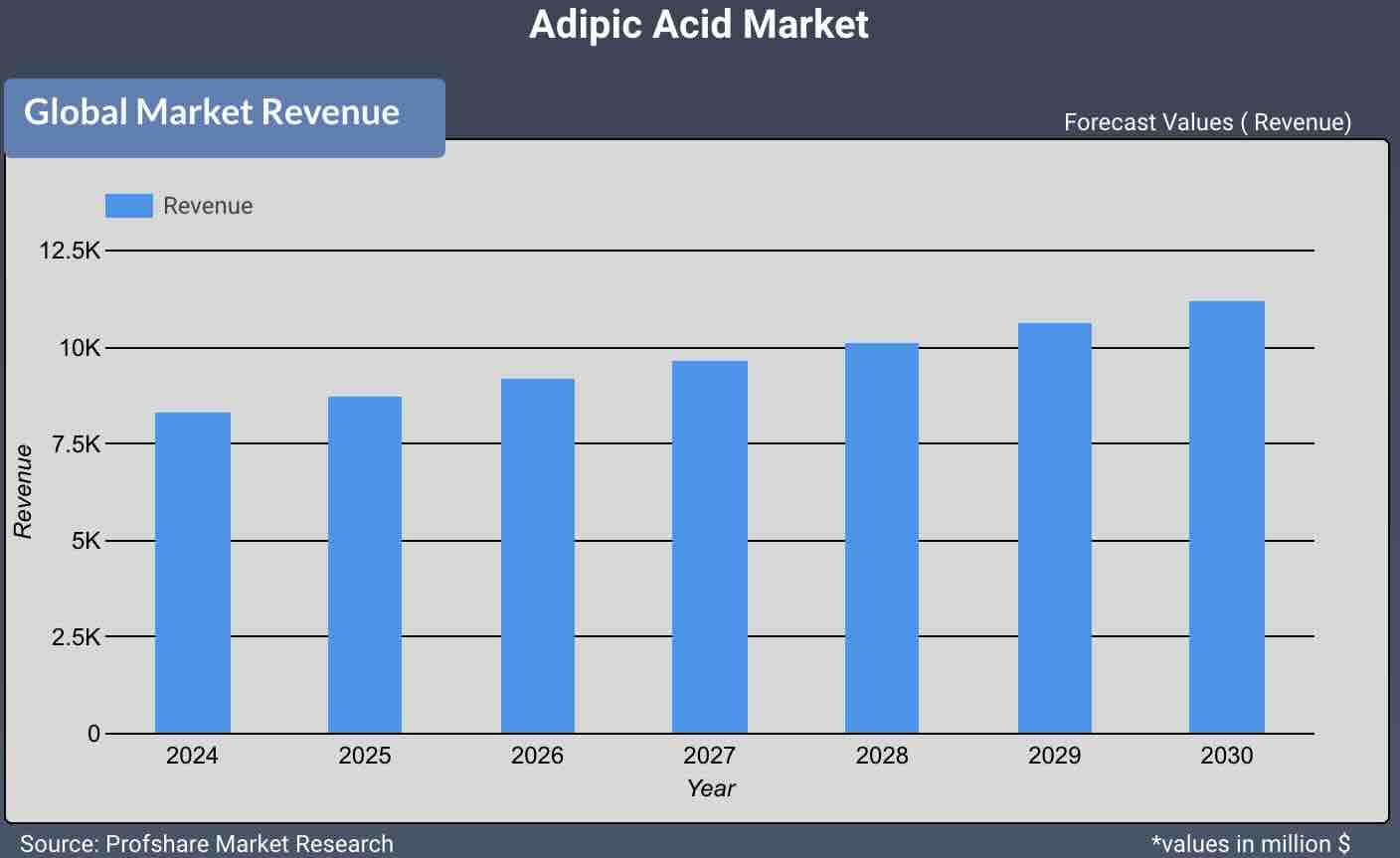
Process type & Competitive analysis
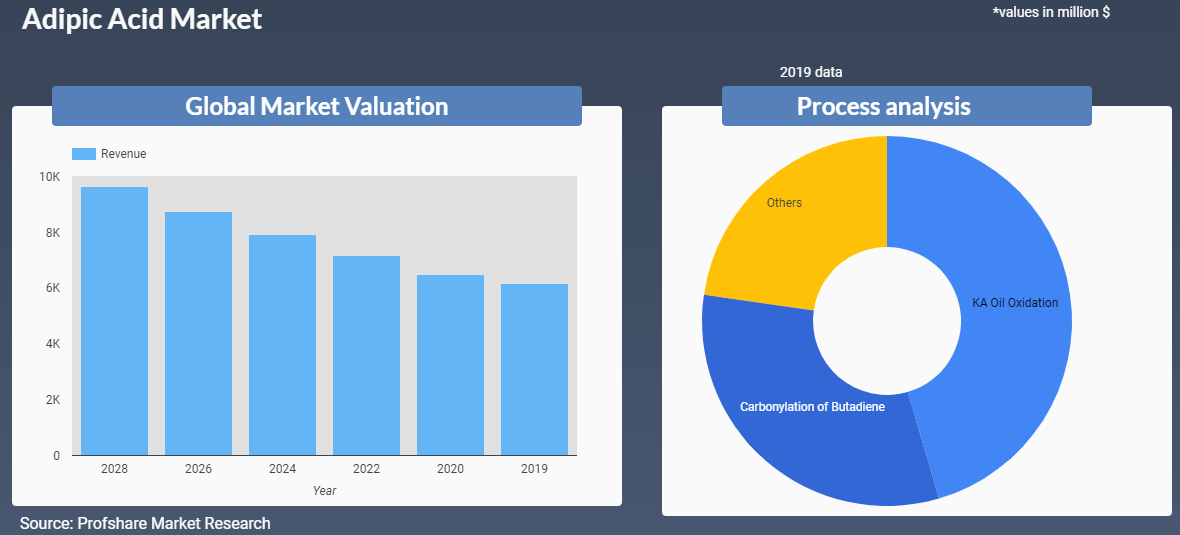
Adipic Acid being one of the most important monomers in the polymer industry can be manufactured with various chemical compounds using different process. Report analysed market for KA Oil ( Cyclohexane + Cyclohexene) Oxidation and Carbonylation of Butadiene process an in-detaileds. Widely used method is KA Oil ( Cyclohexane + Cyclohexene) Oxidation with nitric acid (HNO3) . This process covers around 70 % of market share followed by Carbonylation of Butadiene. Even though KA oil Oxidation with nitric acid is easy process but also considered to be most environmental damaging due to copious amounts of nitrous oxide (N2O), a greenhouse gas production by the use of nitric acid (HNO3).Competitive analysis included in research study helps users to understand key players market positioning and marketing strategies. Adipic Acid manufacture always facing environmental pollution problems as it is insoluble in water and greenhouse gas produced during the manufacturing. According to New Jersey Dept of Health it Adipic Acid has many hazardous effects on Human-like breathing problem, irritation of Eyes & Skin. Manufactures needs to take precise measures to avoid these effects on workers. Market giants like BASF are investing more on R & D to reduce environment damage caused due to production of Adipic Acid. BASF N2O decomposition catalyst series O3-81 reduce N2O especially from Adipic Acid plants.
Application & Regional analysis
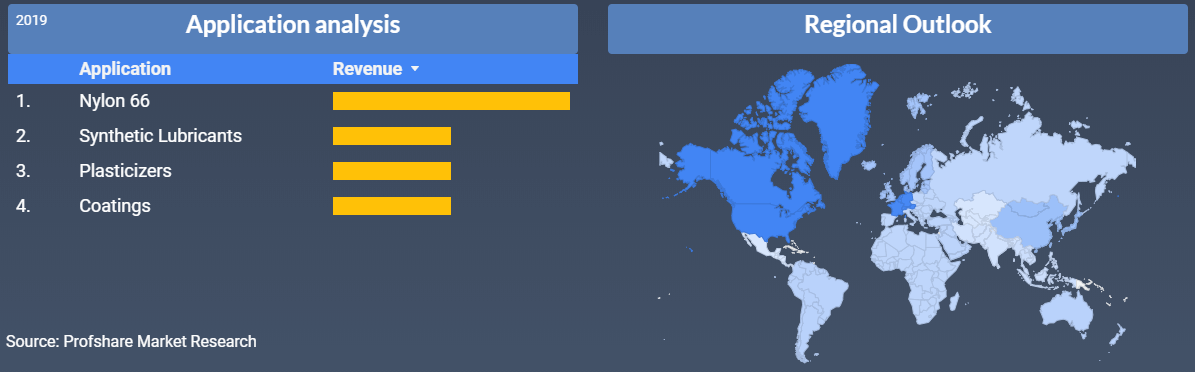
As a one of the most important monomers in the polymer industry Adipic Acid has many applications. Some of the primary applications of product include in manufacturing of Nylon 66, Synthetic Lubricants, and Plasticizers & Coatings. Adipic Acid in manufacturing of Nylon 66 generated around USD 5247 million revenue that is around 85 % of total revenue. Impressive resistance properties of Nylon 66 against heat as well as oil and grease driving the growth of Nylon 66 Market. Synthetic Lubricants and Plasticizers market is expected to show constant growth in forecasted years.
Regional outlook of research study is based on analysis of Adipic Acid Market in North America, Europe, Asia Pacific, Middle East, South America, and Africa & Rest of the World. Currently, North America is market leader with around 38 % of market share followed by Europe & Asia Pacific. North America is expected to show constant demand growth in upcoming years due to Nylon 66 high usage in automobile tire cord. Asia Pacific is emerging as most lucrative market since 2009 primarily due to exponential growth in Automobile & Textile industry. Adipic Acid Market in Middle East also shown impressive growth rate primarily due to the establishment of manufacturing plants.
Research study has extensively worked on supply-demand analysis which has become important parameter in Chemical industry. Supplier analysis helps to understand supply- demand scenario that certainly helps designed better manufacturing process. Analytical tools used while developing research studies include Porter's 5 Forces model, PESTEL analysis, SWOT analysis, market sizing. Opportunities and threat analysis have gaineded significant importance in recent years primarily due to dynamic nature of chemical industry.
Global Adipic Acid Market: Production Process
- KA Oil ( Cyclohexane + Cyclohexene) Oxidation with nitric acid (HNO3)
- Carbonylation of Butadiene
- Others
Global Adipic Acid Market: Application
- Nylon 66
- Synthetic Lubricants
- Plasticizers
- Coatings
Global Adipic Acid Market: Competitive Analysis
Report includes accurate analysis of key players with Market Value, Company profile, SWOT analysis. The Study consists of following key players in Global Adipic Acid Market:
- Asahi Kasei
- DuPont
- Lanxess
- Sumitomo Chemicals
- BASF
- DSM
- Ascend Performance Materials
- Invista
- Rhodia
- Ascend
- Radici
- Haili
- Huafon
- Shenma Industrial
- Hualu-Hengsheng
- Zhejiang Shuyang
- Kailuan Group
- Liaoyang Sinopec
- Hongye
- Tianli
- Yangmei Fengxi
Geographical analysis of Global Adipic Acid Market:
-
North America
- U.S.A
- Canada
- Mexico
- Rest of NA
- Europe
- France
- Germany
- UK
- Rest of Europe
- Asia Pacific
- China
- Japan
- India
- Singapore
- Rest of APAC
- Latin America
- Middle East
- Africa
- Rest of World
Basic Chemicals and Petrochemicals Landscape
Report Coverage
| Parameter | Details |
|---|---|
| Base Year | 2025 |
| Historical Data | 2020 – 2025 |
| Forecast Period | 2026 – 2032 |
| Base Year Value | USD 7.17 Billion |
| Forecast Value | USD 10.15 Billion |
| CAGR | 5.1% |
| Regional Scope | North America · Europe · Asia-Pacific · Latin America · MEA · RoW |
Frequently Asked Questions
Adipic Acid Market was valued at USD 7.17 Billion in 2025 and is estimated to reach USD 10.15 Billion by 2032.
Adipic Acid Market is projected to grow at a CAGR of 5.1% during 2025–2032.
Adipic Acid Market is dominated by the Nylon 66 segment and the North America region holds the highest market share in 2025.
Some of the top key players in the Adipic Acid Market are BASF, Invista, Ascend Performance Materials, Lanxess, RadiciGroup, Solvay, Toray Industries, Shandong Haili.
Primary driving factors for the growth of the Adipic Acid Market include Nylon 66 high usage in automobile tire cord along with exponential growth in Automobile & Textile industry in APAC region.
Yes. The report includes a dedicated section on geopolitical risk factors and their impact on supply chains, pricing, and regional demand dynamics.