
Computational Photography Market Overview
The Computational Photography Market was valued at USD 14.03 Billion in 2025 and is projected to reach USD 74.78 Billion by 2032, growing at a CAGR of 27% during 2026–2032, with North America holding the largest share.
Primary Drivers
- Rising smartphone camera competition is driving rapid adoption of AI-powered computational photography features (night mode, portrait mode, multi-frame HDR) as a key differentiator.
- Growing integration of computational photography in automotive, security and machine-vision applications is expanding demand beyond consumer smartphones.
- Advances in on-device AI chip performance are enabling increasingly sophisticated real-time image processing, broadening feature sets across price tiers.
Primary Challenges
- Rapid technology iteration cycles require continuous R&D investment, creating pressure for smaller camera-module and chip suppliers to keep pace.
- Computational photography software algorithms are often proprietary and tightly integrated with specific chipsets, limiting interoperability and increasing vendor lock-in risk.
- Diminishing returns and consumer feature fatigue in mature smartphone markets could slow the pace of premium feature-driven upgrade cycles.
This report includes a dedicated chapter covering supply chain exposure, export controls, sanctions risk, and regulatory shifts affecting Computational Photography Market.
Computational Photography Market Strategic Outlook
Computational photography is an emerging research field that attempts to extend or enhance the capabilities of digital photography by adding computational elements to the imaging process. Computational imaging techniques that enhance or extend the capabilities of digital photography – output is an ordinary photograph, but one that could not have been taken by a traditional photography. Computational photography can capture the visual information by exploiting the synergistic combination of task-specific optics, illumination, and sensors challenging traditional digital cameras’ limitations.
Growth trajectory, 2026–2032
How this market is covered
Revenue split by type
Revenue by end use
Key aspects of Computational photography includes:
- Improved dynamic range
- Variable focus, resolution, and depth of field
- Aesthetic image framing
- Content-based image editing
- Hints about shape, reflectance, and lighting
- New interactive forms of photography
Computational photography can capture the visual information by exploiting the synergistic combination of task-specific optics, illumination, and sensors challenging traditional digital cameras’ limitations. Computational photography has broad applications in aesthetic and technical photography, 3D imaging, medical imaging, human-computer interaction, virtual/augmented reality and more.
Technological advancement in Computational photography have involved in more challenging issues to break traditional photography’s limitation. In digital refocusing technique controls DOF (Depth of Field) by software processing after shooting. In traditional photography practically no way to recover well focused photos by traditional methods such as deblurring functions in Photoshop. As of this ill-focused photo degrades the experience of real photography. Digital refocusing technique provides a good solution for such cases. Likewise, computational photography researches have been broadening the borders of photography making imaginary 3 functions possible. In such stream, I convince modern cameras will be evolved to more innovative forms.
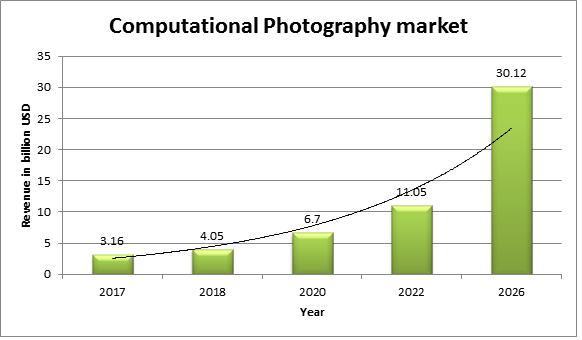
Computational Photography Market: Technology Type
- Tone mapping
- Defocus Matting
- Motion magnification
- Multi-Modal Imaging
Computational Photography Market: Processing
- Single Lens Cameras
- Dual Lens Cameras
- Lens Cameras
Computational Photography Market: Operation Type
- Camera Module
- Software
Computational Photography Market: Application
- Smartphone Camera
- Standalone Camera
- Machine Vision
Computational Photography Market : Competitive Analysis
Report includes accurate analysis of key players with Market Value, Company profile, SWOT analysis. The Study consists of following key players in Computational Photography Market:
- Alphabet
- Samsung Electronics
- Qualcomm Technologies
- Lytro
- Nvidia
- Canon
- Nikon
- Sony
- On Semiconductors
- Pelican Imaging
- Almalence
- Movidius
- Algolux
- Corephotonics
- Dxo Labs
- Affinity Media
Geographical analysis of Computational Photography Market:
-
North America
- U.S.A
- Canada
- Europe
- France
- Germany
- Spain
- UK
- Rest of Europe
- Asia Pacific
- China
- Japan
- India
- South East Asia
- Latin America
- Brazil
- Middle East and Africa
Semiconductor Devices (ICs & Chips) Landscape
Report Coverage
| Parameter | Details |
|---|---|
| Base Year | 2025 |
| Historical Data | 2020 – 2025 |
| Forecast Period | 2026 – 2032 |
| Base Year Value | USD 14.03 Billion |
| Forecast Value | USD 74.78 Billion |
| CAGR | 27% |
| Regional Scope | North America · Europe · Asia-Pacific · Latin America · MEA · RoW |
Frequently Asked Questions
Computational Photography Market was valued at USD 14.03 Billion in 2025 and is estimated to reach USD 74.78 Billion by 2032.
Computational Photography Market is projected to grow at a CAGR of 27% during 2025–2032.
Computational Photography Market is dominated by the Smartphone Camera segment and the North America region holds the highest market share in 2025.
Some of the top key players in the Computational Photography Market are Almalence, Sony, Dxo Labs, Pelican Imaging, Canon, Nilkon, Lytro, Nvidia.
1. Rising smartphone camera competition is driving rapid adoption of AI-powered computational photography features (night mode, portrait mode, multi-frame HDR) as a key differentiator. 2. Growing integration of computational photography in automotive, security and machine-vision applications is expanding demand beyond consumer smartphones. 3. Advances in on-device AI chip performance are enabling increasingly sophisticated real-time image processing, broadening feature sets across price tiers.
Yes. The report includes a dedicated section on geopolitical risk factors and their impact on supply chains, pricing, and regional demand dynamics.