
Non-GM Soy Oil Market Overview
The Non-GM Soy Oil Market was valued at USD 5.79 Billion in 2025 and is projected to reach USD 7.29 Billion by 2032, growing at a CAGR of 3.3% during 2026–2032, with Asia-Pacific holding the largest share.
Primary Drivers
- Rising consumer awareness of health and wellness is driving demand for non-GMO cooking oils.
- Growing demand for plant-based food products is expanding non-GM soy oil applications.
- Increasing adoption of non-GMO ingredients in food and beverage manufacturing is supporting growth.
Primary Challenges
- A crowded field of established edible oil producers keeps competitive pricing pressure elevated.
- Higher production costs for verified non-GMO sourcing can compress margins for processors.
- Volatile soybean commodity prices can create unpredictable margin pressure for manufacturers.
This report includes a dedicated chapter covering supply chain exposure, export controls, sanctions risk, and regulatory shifts affecting Non-GM Soy Oil Market .
Non-GM Soy Oil Market Strategic Outlook
Growth trajectory, 2026–2032
How this market is covered
Revenue split by type
Revenue by end use
Global Non-GM Soy Oil Market is estimated to show CAGR of 5.3 % between 2019 and 2027
Overview
Non-GM soy oil is a popular non-GM alternative to regular Soybean Oil and to improve the quality of soy oil, Soy has been genetically modified. Soy oil has a fatty acid profile. This fatty acid profile makes it susceptible to oxidation and this has limited its usefulness to the food industry. The major cooking oils, olive, sunflower, and peanut oil come from crops where no GM technology is used. In addition, any organic form of soy or canola oil would not make use of any GM technology. However, by doing process, one cannot tell the change between GM and non-GM soy and canola cooking oils. Soy contains is flavones, which act like estrogen in the body. Since many breast cancers need estrogen to grow, it would stand to reason that soy could increase breast cancer risk. The seeds used for the Non-GM Soy oil are made from a strain that has not been genetically modified. It has a low cost in comparison to other related oils, and is one of the most commonly used vegetable oils in the world.
Non-GM market situation has interchanged rapidly since last spring, and is still expanding. Changes are being led by foreign consumer concerns. The Non-GM soy oil offered by vippy industries ltd, a leading supplier of soy oil in industrial area like dewas and MP. Soy oil is the second most important vegetable oil. It accounts for twenty five percent of global vegetable oils and fats consumption. The widespread use of soy oil in particular as edible oil is due to its plentiful and dependable supplies, its competitive price and its neutral flavor and stability in both hydrogenated and unhydrofenated form is driving the demand for soy oil. Recent trade reports indicate premiums have been in a five to thirty five cent range for non-GMO soybeans at some markets. Demand for the company’s high quality oil is strong and its one twenty farmers earn premium prices growing non-GM, low lin soybean to make the oil. Zeeland farm services is an industry leader in the development and production of non-GM soy oil, offering a variety of products for both the food services and retail markets.
Product type & Competitive analysis
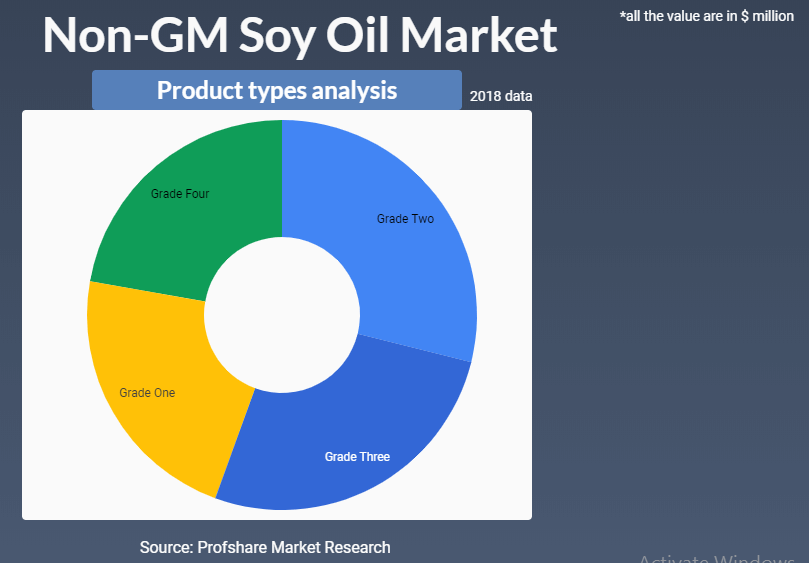
Non-GM soy oil Market is divided into four types which are grade one, grade two, grade three and grade four. Six factors are considered in assigning a grade designation: test weight, amounts of beans that are damaged or heat damaged, and amounts of foreign material, splits, and soybeans of other colours. Grade one of Non-GM soy oil have HPS quality type and yellow colour soya bean. It contains minimum fifty four percent of protein and moisture content is of fourteen percent. Grade two soy oil has protective beans. It contains proteins, fats, fiber, calcium, iron and other ingredients. Grade two also contains same percent of proteins, moisture content and type as grade one contains. The grade three and grade four are less used in cooking as compared to grade one and grade two. This types of grades may be used for some other purpose also.
Application & Regional analysis
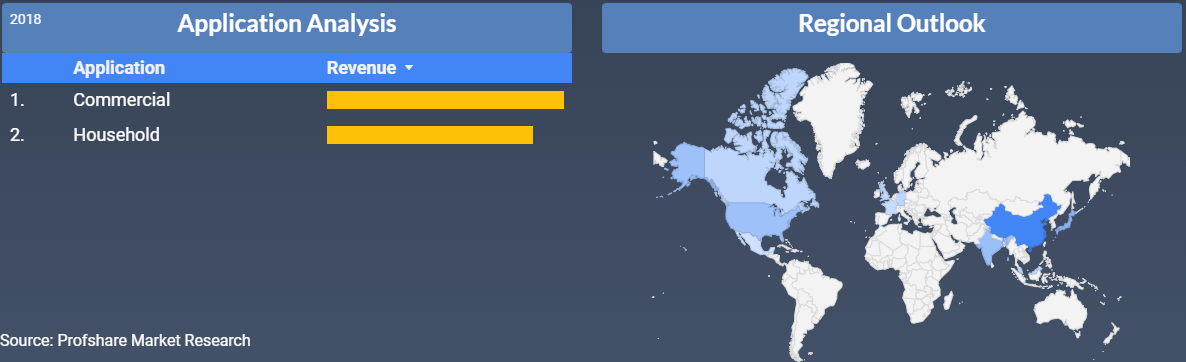
Application wise, the Non-GM soy oil has divided into two applications which are household and commercial. The Non-GM soy oil is used in both Household as well as at commercial palaces but as compared to commercial, Non-GM soy oil is mostly used in household and people are demanding of that. Non-GM soy oil is healthy to consume as compared to GM soy oil. These might be the reason behind choosing Non-GM soy oil for household purpose.
On the basis of geographical analysis, Non-GM soy oil is divide into various areas like North America, Europe, China, Japan, Southeast Asia, and India. The global Non-GM soy oil market presents a profound evaluation of basic elements of Non-GM soy oil industry such as production scale and profit generation. The use of Non-GM Soy oil is even more important if you are using it outside of the US. There is a governmental requirement that insists on only Non-GM oils, for anyone exporting to Europe, South Korea and other pan-Asia countries. The Asia Pacific will occupy for more market share in following years, especially in China, Also fast growing in India and Southeast Asia regions.
Global Non-GM Soy Oil Market : Product Type
- Grade One
- Grade Two
- Grade Three
- Grade Four
Global Non-GM Soy Oil Market : Application
- Household
- Commercial
Global Non-GM Soy Oil Market : Competitive Analysis
Report includes accurate analysis of key players with Market Value, Company profile, SWOT analysis. The Study consists of following key players in Global Non-GM Soy Oil Market :
- ADM
- Bunge
- Cargill
- Louis Dreyfus
- Wilmar International
- Arkema
- Cofco
- Donlinks
- Shandong Bohi Industry
- Henan Sunshine Group Corporation
- Nanjing Bunge
- Xiamen Zhongsheng
- Hunan Jinlong
- Sanhe hopefull
- Xiangchi Scents Holding
- Dalian Huanong
- Yihai Kerry
- Shandong Sanwei
Geographical analysis of Global Non-GM Soy Oil Market :
-
North America
- U.S.A
- Canada
- Europe
- France
- Germany
- Spain
- UK
- Rest of Europe
- Asia Pacific
- China
- Japan
- India
- South East Asia
- Latin America
- Brazil
- Middle East and Africa
Global Non-GM Soy Oil Market Report delivers a comprehensive analysis of the following parameters :
- Market Forecast for 2023-29
- Market growth drivers
- Challenges and Opportunities
- Emerging and Current market trends
- Market player Capacity, Production, Revenue (Value)
- Supply (Production), Consumption, Export, Import analysis
- End-user/application Analysis
Processed & Convenience Foods Landscape
Report Coverage
| Parameter | Details |
|---|---|
| Base Year | 2025 |
| Historical Data | 2020 – 2025 |
| Forecast Period | 2026 – 2032 |
| Base Year Value | USD 5.79 Billion |
| Forecast Value | USD 7.29 Billion |
| CAGR | 3.3% |
| Regional Scope | North America · Europe · Asia-Pacific · Latin America · MEA · RoW |
Frequently Asked Questions
Non-GM Soy Oil Market was valued at USD 5.79 Billion in 2025 and is estimated to reach USD 7.29 Billion by 2032.
Non-GM Soy Oil Market is projected to grow at a CAGR of 3.3% during 2025–2032.
1. Rising consumer awareness of health and wellness is driving demand for non-GMO cooking oils. 2. Growing demand for plant-based food products is expanding non-GM soy oil applications. 3. Increasing adoption of non-GMO ingredients in food and beverage manufacturing is supporting growth.
Yes. The report includes a dedicated section on geopolitical risk factors and their impact on supply chains, pricing, and regional demand dynamics.