
This report includes a dedicated chapter covering supply chain exposure, export controls, sanctions risk, and regulatory shifts affecting Low Power Cables Market.
Low Power Cables Market Strategic Outlook
Low Voltage Power Cable can be used in either wet or dry applications. It is sunlight and impact resistant. It is available in various reel sizes, and reel-less packages. These utility cables are specially designed to be easy to handle and install. Low voltage power cables carry Single Aluminium Conductor Underground Power Utility Cable, which is made from the cross-linked polyethylene (XLPE) insulation, for underground applications requiring 600 volts or less.
Market Forecast 2026–2032
⬇ Download Chart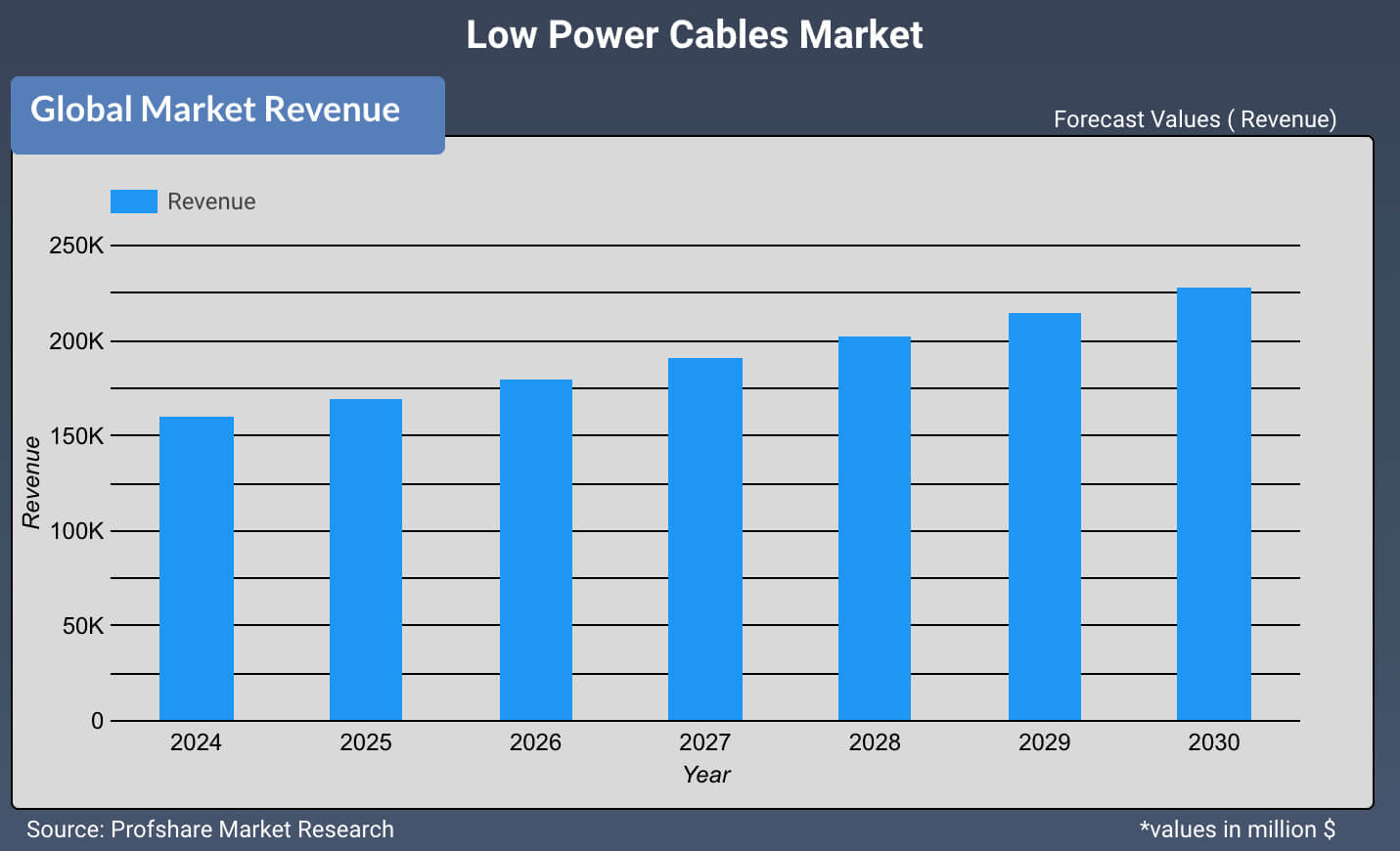
Low Voltage Power Cable is segmented into copper cable and aluminium cable. It is widely used because copper cable wire is more ductile and less prone to electrical contact problems and thus offers a greater margin of safety than a corresponding aluminium cable. Driving growth factor for this segment is Due to its smaller cross-section, the copper cable will also be easier to install and also is less susceptible to electricity It is easier to install because the stiffness of the cable depends on the square of the cross-sectional area.
Aluminium cable is only available at nominal cross-sectional areas of at least 10 mm2 and the individual strands are still very thick compared to those in the equivalently sized copper cable. Technically so-called ‘finely stranded’ and ‘extra finely stranded’ conductors are only available in copper. aluminium conductors available are significantly stiffer than the finest copper conductors and this difference has on occasion led to some rather costly surprises.
In competition analysis report covers key players basic information, product category, Sales (Volume), Revenue (Million USD), Price (USD/Unit) and Gross Margin (%). The competitive landscape in the report offers detailed profiles of the key players in Desalination Systems Market. The report also covers financial overview, market strategies, new product analysis and marketing trends. Precise Competitive analysis helps businesses to build new product strategies.
Market of global Low Power Cables is dominated by Asia-Pacific and It had registered for a share of around 42%. Due to rise in industrialization and urbanization in Asia-Pacific is a major factor for the growth of the low voltage cable & accessories market in this region. growth of the low Voltage cable market is contributed by China, U.S., India, Germany, U.K., Brazil, Canada, Saudi Arabia, South Africa, and Japan.
The Major players in the global low voltage cable market include Prysmian S.P.A (Italy), Nexans S.A. (France), General Cable Corporation (U.S.), Sumitomo Electric Industries (Japan), and NKT Cables Group GmbH (Germany).
Low Power Cables Market : Product Type
- Copper
- Aluminum
Low Power Cables Market : End User / Application
- Industrial System
- Residence System
Low Power Cables Market: Companies Covered
- Nexans
- General Cable
- NKT
- Prysmian Group
- Sumitomo Electric
- Southwire Company
- Belden
- Eaton
- LS Cable & Systems
- Hengtong Group
- Encore Wire
- TPC Wire & Cable
- Finolex
- KEI Industries
Geographical analysis of Low Power Cables Market includes :
- North America
- Europe
- China
- Japan
- Southeast Asia
- India
- Africa
- Latin America
Electrical Components and Infrastructure Landscape
Report Coverage
| Parameter | Details |
|---|---|
| Base Year | 2026 |
| Historical Data | 2020 – 2025 |
| Forecast Period | 2026 – 2032 |
| Base Year Value | USD 151.04 Billion |
| Forecast Value | USD 228.61 Billion |
| CAGR | 6.1% |
| Regional Scope | North America · Europe · Asia-Pacific · Latin America · MEA · RoW |
Frequently Asked Questions
Low Power Cables Market was valued at USD 151.04 Billion in 2026 and is estimated to reach USD 228.61 Billion by 2032.
Low Power Cables Market is projected to grow at a CAGR of 6.1% during 2026–2032, driven by rising demand across industrial and specialty applications.
Low Power Cables Market is dominated by the Copper segment and the Asia Pacific region holds the highest market share in 2025.
Some of the top key players in the Low Power Cables Market are Nexans, General Cable, NKT, Prysmian Group, Sumitomo Electric, Southwire Company, Belden, Eaton, LS Cable & Systems, Hengtong Group, Encore Wire, TPC Wire & Cable, Finolex, KEI Industries.
Primary driving factors for the growth of the Low Power Cables Market include Rise in industrialization and urbanization.
Yes. The report includes a dedicated section on geopolitical risk factors and their impact on supply chains, pricing, and regional demand dynamics.