
This report includes a dedicated chapter covering supply chain exposure, export controls, sanctions risk, and regulatory shifts affecting Horizontal Axis Wind Turbines Market.
Horizontal Axis Wind Turbines Market Strategic Outlook
A horizontal-axis wind turbine (HAWT) is a wind turbine in which the axis of the rotor's rotation is parallel to the wind stream and the ground. Horizontal-axis wind turbines consists of an electrical generator and main rotor shaft pointed into or out of the wind the top of the tower. The purpose of horizontal-axis wind turbine is to extract energy from the wind most of the times for electricity generation. Horizontal-axis wind turbine are generally two or three bladed built with a propeller type rotor on a horizontal axis. The generator is driven when the rotor converts the linear motion of the wind into rotational energy. The wind passes through the airfoil shaped blades. It passes a great speed over the longer side of the blade which creates a lower pressure area above the airfoil resulting in the rotation of the blades. The rotation of the blades thus generates energy.
Market Forecast 2026–2032
⬇ Download Chart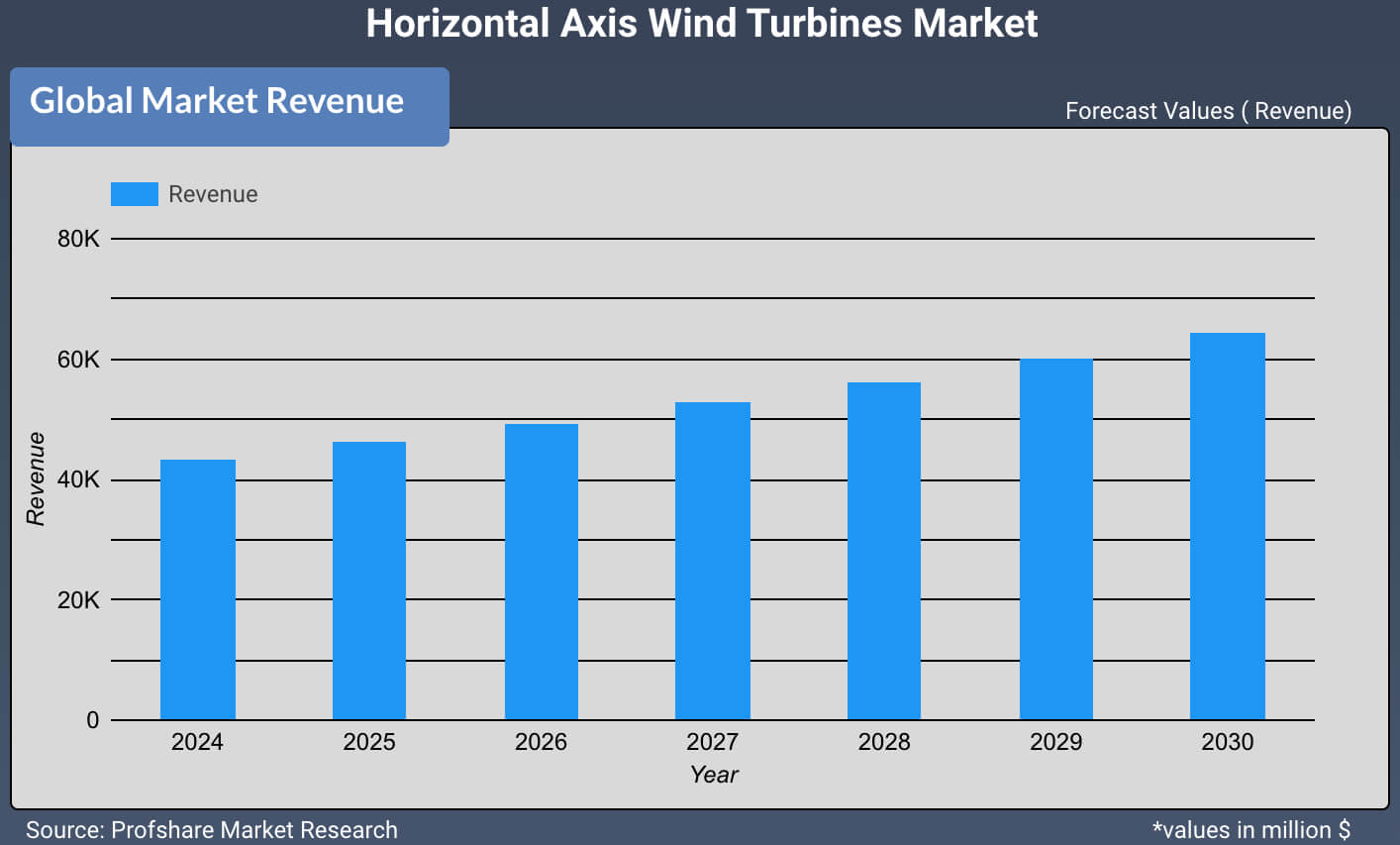
The Global Horizontal Axis Wind Turbines Market is expected to make a significant growth in the forecasted period. The growing adaptation of the concept of generating renewable energy with the use of the equipment such as turbines and solar panels is going to increase the demand for Horizontal Axis Wind Turbines. Renewable energy is collected from natural resources such as water wind and sunlight. Horizontal Axis Wind Turbines are used to generate the renewable energy through wind. The major focus of the key players globally is to install the equipment used to collect renewable energy which is resulting in the growth of the Horizontal Axis Wind Turbines market. The Technological advancement in Horizontal Axis Wind Turbines has made its installation cost effective and less time consuming which has influenced the people to install it in their farms or fields resulting in increase in the demand for Horizontal Axis Wind Turbines
The study covers a detailed analysis, growth and forecast of the Horizontal Axis Wind Turbines Market. The report includes market analysis on global and regional level. The study covers historical data analysis from 2020 and 2025 and market forecast for 2026 and 2032 based on revenue generated. The study includes market value in terms of revenue in million USD for years 2018-2030 and compound annual growth rate (CAGR) in % from 2026 and 2032. The market is expected to show constant growth between 2026 and 2032.
The report comprises value chain analysis for each of the product segments. Value chain analysis offers in-depth information about value addition at each stage. The study includes drivers and restraints for Horizontal Axis Wind Turbines Market along with their impact on demand during the forecast period. The study also provides key market indicators affecting the growth of the market. Research report includes major player analysis with shares of each player inside market, growth rate and market attractiveness in different end-users/regions. Our study Horizontal Axis Wind Turbines Market helps users to make precise decision to expand their market presence and increase market share.
The report provides Horizontal Axis Wind Turbines Market Dynamics, includes industry growth drivers, challenges, opportunities, risk, constraints as well as threats. Report also includes Manufacturing Cost Analysis mainly included Raw Materials Analysis, Price Trend of product, Mergers & Acquisitions, Expansion, Key Suppliers of product, Concentration Rate of Horizontal Axis Wind Turbines Market, Manufacturing Process Analysis. Research Report contains Market Effect Factors analysis mainly included Technology Progress, Consumer Needs Trend, External Environmental Change.
Global Horizontal Axis Wind Turbines Market: Product Type
- On the basis of size
- Small Turbines
- Large turbines
- On the basis of operations
- upwind wind turbine
- downwind wind turbine
Global Horizontal Axis Wind Turbines Market: Application
- On-Grid
- Off-Grid
Global Horizontal Axis Wind Turbines Market: Competitive Analysis
Report includes accurate analysis of key players with Market Value, Company profile, SWOT analysis. The Study consists of following key players in Global Horizontal Axis Wind Turbines Market:
- Northern Power Systems
- Wind Energy Solutions
- Kingspan Group PLC
- Ghrepower Green Energy
- Endurance Wind Power
- Fortis Wind Energy
- WinPower Energy
- Nanjing Oulu
- Bergey Windpower
- Polaris America
- Britwind
- HY Energy
- XZERES
Geographical analysis of Global Horizontal Axis Wind Turbines Market:
-
North America
- U.S.A
- Canada
- Europe
- France
- Germany
- Spain
- UK
- Rest of Europe
- Asia Pacific
- China
- Japan
- India
- South East Asia
- Latin America
- Brazil
- Middle East and Africa
Report Coverage
| Parameter | Details |
|---|---|
| Base Year | 2026 |
| Historical Data | 2020 – 2025 |
| Forecast Period | 2026 – 2032 |
| Base Year Value | USD 40.63 Billion |
| Forecast Value | USD 64.39 Billion |
| CAGR | 6.8% |
| Regional Scope | North America · Europe · Asia-Pacific · Latin America · MEA · RoW |
Frequently Asked Questions
Horizontal Axis Wind Turbines Market was valued at USD 40.63 Billion in 2026 and is estimated to reach USD 64.39 Billion by 2032.
Horizontal Axis Wind Turbines Market is projected to grow at a CAGR of 6.8% during 2026–2032, driven by rising demand across industrial and specialty applications.
Horizontal Axis Wind Turbines Market is dominated by the On-Grid segment and the Asia-Pacific region holds the highest market share in 2025.
Some of the top key players in the Horizontal Axis Wind Turbines Market are Vestas, Siemens Gamesa, GE Renewable Energy, Nordex, Goldwind, Enercon, Suzlon Energy, Mingyang Smart Energy.
Primary driving factors for the growth of the Horizontal Axis Wind Turbines Market include The growing adaptation of the concept of generating renewable energy with the use of the equipment such as turbines and solar panels.
Yes. The report includes a dedicated section on geopolitical risk factors and their impact on supply chains, pricing, and regional demand dynamics.