
Hematology Analyzers Market Overview
The Hematology Analyzers Market was valued at USD 2.71 Billion in 2025 and is projected to reach USD 4.34 Billion by 2032, growing at a CAGR of 7% during 2026–2032, with North America holding the largest share.
Primary Drivers
- Rising global prevalence of blood disorders and increasing routine diagnostic testing are driving strong hematology analyzer demand.
- Growing adoption of fully automated, high-throughput analyzers in hospital and diagnostic laboratories is boosting institutional procurement.
- Increasing healthcare infrastructure investment in emerging economies is expanding access to advanced hematology diagnostic equipment.
Primary Challenges
- High costs of advanced, fully automated hematology analyzers limit accessibility in developing and price-sensitive healthcare markets.
- Reimbursement constraints and inconsistent insurance coverage across regions can restrict testing volumes.
- Intense competition among established diagnostic equipment manufacturers creates continuous pricing pressure.
This report includes a dedicated chapter covering supply chain exposure, export controls, sanctions risk, and regulatory shifts affecting Hematology Analyzers Market.
Hematology Analyzers Market Strategic Outlook
Overview
Hematology analyzers are extensively used in diagnostic laboratories and research facilities to run tests on blood samples. Hematology analyzers are used to perform a variety of blood tests which include white blood cell count tests, red blood cell count tests, complete blood counts, coagulation tests, platelet count tests, hemoglobin concentration tests, and reticulocyte analysis tests. The market offers several automatic and semiautomatic hematology analyzers with varying features.
Today manufacturers are offering novel analyzers that are capable of performing several tests in one device with integrated functions of flow cytometry to analyze all types of leukocytes with higher accuracy and precision. The growing prevalence of blood-related diseases, growing population, increasing adoption of automated hematology analyzers in laboratories around the world is driving the growth of the Hematology Analyzers Market. However, high cost, lack of skilled professionals, contradictions over results, and efficacy are hampering the growth of the Global Hematology Analyzers Market. Technological advancements in design, integration of new technologies, increased automation in workflows, and accuracy of volume measurements will offer several growth opportunities for the market in the forecast period 2026-2032.
Growth trajectory, 2026–2032
How this market is covered
Revenue split by type
Revenue by end use
Product type & Competitive analysis
Hematology Analyzers Market Research Report is segmented as Automatic and Semi-automatic. Several types of automatic and semiautomatic hematology analyzers are available in the market as per the general needs of the laboratory, features, type of clinical tests, and the number of tests performed in the facility. The automatic segment accounted for a major share in the Global Hematology Analyzers Market, in 2025. Automated hematology analyzers in the healthcare sector are widely used across clinical laboratories and healthcare facilities as they help in reducing errors and improve laboratory productivity.
Competitive analysis included in research study helps users to understand key players market positioning and marketing strategies. Major players in the market are launching new products with innovative features to build their portfolios and establish a strong grip on the market. Many hematology analyzers in the market are offering products with higher accuracy, and multiple tests over a single platform in less time with greater automation in features. For instance, in May 2020 Beckman Coulter launched DxH 690T mid-volume hematology analyzer in the U.S. market.
The new hematology analyzer is designed to modernize workflow and minimize interruption in laboratories. The DxH 690T is equipped with modern features such as the Early Sepsis Indicator (ESId). ESId is an FDA-approved cellular biomarker that helps to identify patients with sepsis or the ones at risk of developing sepsis. Companies are also focusing on the development of reagents, integration of data analysis tools to increase result accuracy, and hydrofluidics to enhance the speed of the analyzer. In addition to product development companies are collaborating with key players in the market to offer new products to the market. In September 2020 Agappe Diagnostics Ltd introduced a new hematology analyzer Mispa Count X which is designed in collaboration with L&T Technology Services Limited.
Application & Regional analysis
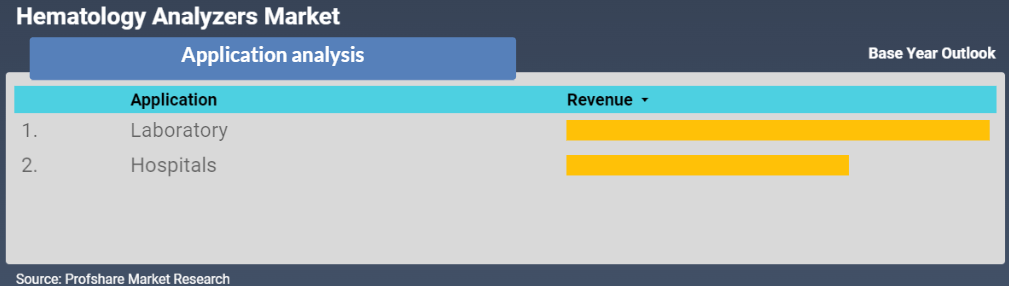
Hematology Analyzers are primarily used in hospitals and laboratories. The laboratory segment accounted for the largest revenue share in 2025 and is projected to lead the market growth over the forecast period. The majority of haematology tests are performed at laboratories due to the presence of advanced equipment and professional experts. The rising frequency of hematology tests, a surge in the number of private laboratories, and growing demand for lab equipment is driving the growth of the segment.
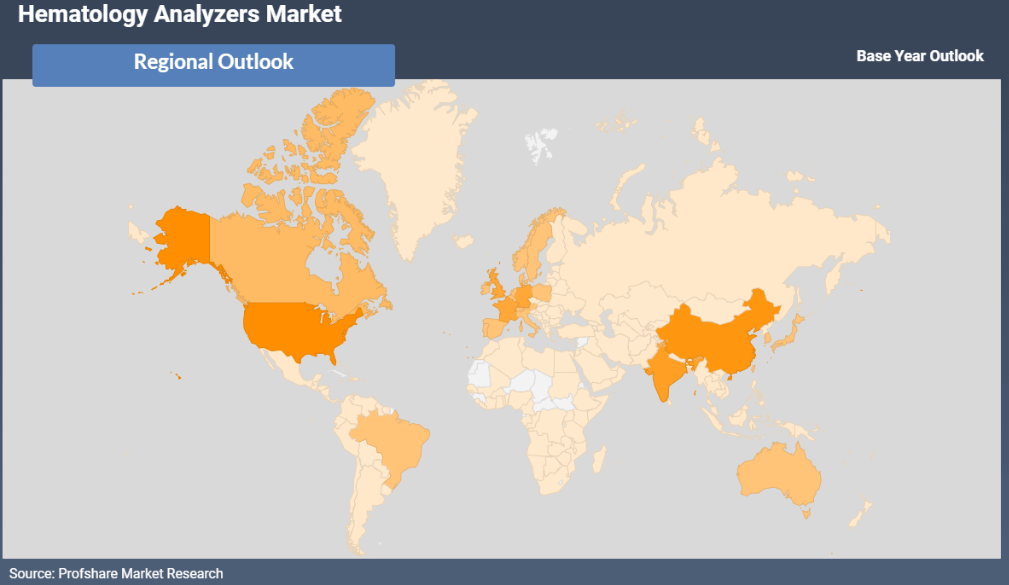
The regional outlook of the research study is based on an analysis of the market in North America, Europe, Asia Pacific, the Middle East, South America, Africa & Rest of the World. North America led the Global Hematology Analyzers Market in 2025. The growth in the region was primarily driven by a significant increase in the number of blood-related tests and the rise in the prevalence of chronic diseases. The U.S. accounted for the largest revenue share in 2025 owing to the presence of advanced healthcare and diagnostic facilities, greater adoption of automated medical equipment in healthcare, and the requirement of a higher number of blood tests for several chronic diseases. According to the Centers for Disease Control and Prevention, chronic diseases are the leading cause of death and disability in the U.S. Diabetes, heart disease, and cancer account for about 3.5 trillion USD in healthcare costs in the country.
Europe was second in terms of revenue generation in 2025 followed by the Asia Pacific. The rising prevalence of blood disorders, the presence of key players, and chronic diseases that require regular blood testing to diagnose and to avail proper medical treatment are some key factors driving the growth of the European market. Asia Pacific is projected to grow at the highest CAGR in the forecast period 2020-2026. The growth in the region was accounted to the rising prevalence of blood-related disorders, developing medical infrastructure, rising geriatric population, and adoption of digital tools and equipment in blood testing laboratories.
A significant rise in the geriatric population in China, Japan, and India will fuel growth in the region in the forecast period. It is estimated that 35 % of China's population will be over 65 years old in 2050. In addition to this growing awareness regarding diseases related to blood, infectious disease diagnosis, and the presence of a significantly large patient pool is expected to foster the growth of the Hematology Analyzers Market in the Asia Pacific.
Hematology Analyzers Market : Product Type
- Automatic
- Semi-automatic
Hematology Analyzers Market : Application Analysis
- Hospitals
- Laboratory
Hematology Analyzers Market : Competitive Analysis
The report includes an accurate analysis of key players with Market Value, Company profile, and SWOT analysis. The Study consists of the following key players in Hematology Analyzers Market :
- Siemens
- Abbott Laboratories
- Sysmex Corp.
- Bio-Rad Laboratories
- Beckman Coulter Inc.
- Roche Ltd.
Geographical analysis of Hematology Analyzers Market :
-
North America
- U.S.A.
- Canada
- Europe
- France
- Germany
- Spain
- UK
- Rest of Europe
- Asia Pacific
- China
- Japan
- India
- South East Asia
- Latin America
- Brazil
- Middle East and Africa
Diagnostic Imaging & Measurement Devices Landscape
Report Coverage
| Parameter | Details |
|---|---|
| Base Year | 2025 |
| Historical Data | 2020 – 2025 |
| Forecast Period | 2026 – 2032 |
| Base Year Value | USD 2.71 Billion |
| Forecast Value | USD 4.34 Billion |
| CAGR | 7% |
| Regional Scope | North America · Europe · Asia-Pacific · Latin America · MEA · RoW |
Frequently Asked Questions
Hematology Analyzers Market was valued at USD 2.71 Billion in 2025 and is estimated to reach USD 4.34 Billion by 2032.
Hematology Analyzers Market is projected to grow at a CAGR of 7% during 2025–2032.
Automatic Hematology Analyzers segment dominates the market in terms of revenue generation. North-America region is the market leader in 2025.
Some of the top companies included in the research report are Exxon Mobil, Weil Group Resources, Praxair Inc., PGNiG, Air Product, Gulf Cryo, Air Liquide SA, Linde AG.
1. Rising global prevalence of blood disorders and increasing routine diagnostic testing are driving strong hematology analyzer demand. 2. Growing adoption of fully automated, high-throughput analyzers in hospital and diagnostic laboratories is boosting institutional procurement. 3. Increasing healthcare infrastructure investment in emerging economies is expanding access to advanced hematology diagnostic equipment.
Yes. The report includes a dedicated section on geopolitical risk factors and their impact on supply chains, pricing, and regional demand dynamics.