
Food Texturizers Market Overview
The Food Texturizers Market was valued at USD 16.73 Billion in 2025 and is projected to reach USD 24.66 Billion by 2032, growing at a CAGR of 5.7% during 2026–2032, with North America holding the largest share.
Primary Drivers
- Rising global demand for convenience and ready-to-eat foods is pushing manufacturers toward texturizers that maintain product stability and mouthfeel over extended shelf life.
- The expansion of plant-based and vegan food categories is driving innovation in texturizers that replicate the sensory qualities of animal-based products.
- Clean-label consumer preferences and technological advances in microencapsulation and enzyme-based emulsification are accelerating the shift toward naturally derived, precision-engineered texturizing solutions, especially in fast-growing Asia Pacific markets.
Primary Challenges
- Fragmented and inconsistent food-additive approval processes across regions raise compliance costs and slow product launches.
- Volatile pricing and supply availability for key raw materials such as guar and locust bean gum threaten manufacturers' cost and supply-chain stability.
- Persistent consumer skepticism toward synthetic or heavily processed additives continues to limit adoption of certain texturizer categories.
This report includes a dedicated chapter covering supply chain exposure, export controls, sanctions risk, and regulatory shifts affecting Food Texturizers Market.
Food Texturizers Market Strategic Outlook
Growth trajectory, 2026–2032
How this market is covered
Revenue split by type
Revenue by end use
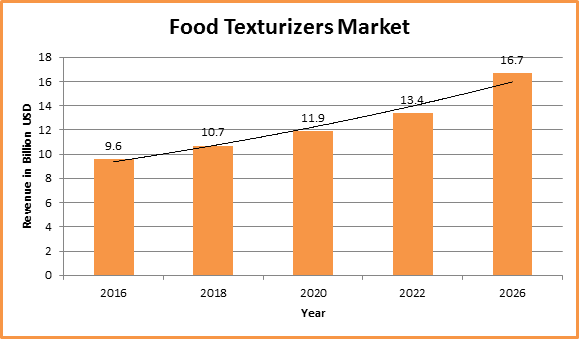
Global Food Texturizers Market is estimated to reach USD 12.3 billion by 2026, growing at a CAGR of 5.7 % between 2018 and 2026
The global food texturizers market is valued at USD 9.6 billion in 2025 and is expected to reach USD 12.3 billion by the end of 2026, growing at a CAGR of 5.7 % between 2017 and 2025. Texturizers are ingredients used to improve texture and stability in food, which help them maintain their structure while providing a creamy feeling in the mouth. Texturizers are used to improve the consumer experience adding a variety of characteristics to food, such as consistency, mouthfeel, crunchy, chewy and taste. They are used alone or in a blend to improve the properties of the end-product, providing a stable structure to the food and increasing its shelf-life.
Gelatin, pectin, guar gum, carrageenan, xanthan gum, and whey are some of the common food texturizers found in food industry. Food are used in foods like frozen desserts, dairy products, cakes, pudding and gelatin mixes, dressings, jams and jellies, beverages, chewing gum and sauces. Food texture analysis provides quality improvement opportunities throughout the supply chain and the production process. The increasing demand from consumer for healthier and natural finished products with minimum sugar and fat having improved taste is driving food texturizers market.
North America is the largest food texturizers market followed by Europe and Asia-Pacific. North America and Europe are largest market due to well established food processing industries and supply chain. Asia Pacific is anticipated to witness an exponential during the forecast period due to its flourishing economy. Increasing urbanization and industrialization with busy lifestyle, rapid increase in convenience foods consumption, increased purchasing power and growing health awareness are increasing demand for processed foods which is boosting global food texturizers market.
Food Texturizers Market : Product Type
- Cellulose Derivatives
- Algae Extract
- Starch
- Dextrins
- Inulin
Food Texturizers Market : Application
- Dairy Products & Ice Creams
- Confectionery
- Bakery
- Beverage
- Meat Products
Global Food Texturizers Market: Competitive Analysis
Report includes accurate analysis of key players with Market Value, Company profile, SWOT analysis. The Study consists of following key players in Global Food Texturizers Market:
- Cargill
- E.I. Dupont
- Royal DSM
- Archer Daniels Midland
- Kerry Group
- Naturex
- FMC Corporation
- Estelle Chemicals
- Lonza Group
- Taiyo Kagaku
- Fiberstar
- Tate & Lyle
- Penford Corporation
- Fuerst Day Lawson
- Ingredion
- Tic Gums
- Puratos Group
- Riken Vitamin
- Premium Ingredients
Geographical analysis of Food Texturizers Market:
-
North America
- U.S.A
- Canada
- Europe
- France
- Germany
- Spain
- UK
- Rest of Europe
- Asia Pacific
- China
- Japan
- India
- South East Asia
- Latin America
- Brazil
- Middle East and Africa
Food Texturizers Market Report delivers a comprehensive analysis of the following parameters :
- Market Forecast for
- Market growth drivers
- Challenges and Opportunities
- Emerging and Current market trends
- Market player Capacity, Production, Revenue (Value)
- Supply (Production), Consumption, Export, Import analysis
- End-user/application Analysis
Ingredients, Additives & Functional Components Landscape
Report Coverage
| Parameter | Details |
|---|---|
| Base Year | 2025 |
| Historical Data | 2020 – 2025 |
| Forecast Period | 2026 – 2032 |
| Base Year Value | USD 16.73 Billion |
| Forecast Value | USD 24.66 Billion |
| CAGR | 5.7% |
| Regional Scope | North America · Europe · Asia-Pacific · Latin America · MEA · RoW |
Frequently Asked Questions
Food Texturizers Market was valued at USD 16.73 Billion in 2025 and is estimated to reach USD 24.66 Billion by 2032.
Food Texturizers Market is projected to grow at a CAGR of 5.7% during 2025–2032.
1. Rising global demand for convenience and ready-to-eat foods is pushing manufacturers toward texturizers that maintain product stability and mouthfeel over extended shelf life. 2. The expansion of plant-based and vegan food categories is driving innovation in texturizers that replicate the sensory qualities of animal-based products. 3. Clean-label consumer preferences and technological advances in microencapsulation and enzyme-based emulsification are accelerating the shift toward naturally derived, precision-engineered texturizing solutions, especially in fast-growing Asia Pacific markets.
Yes. The report includes a dedicated section on geopolitical risk factors and their impact on supply chains, pricing, and regional demand dynamics.