
This report includes a dedicated chapter covering supply chain exposure, export controls, sanctions risk, and regulatory shifts affecting Capsule Coffee Machines Market .
Capsule Coffee Machines Market Strategic Outlook
Capsule coffee machine is a new kind of coffee machine as compared with the ordinary coffee machine. Capsule coffee machine manufacturers put the coffee in a sealed aluminum or plastic capsule in advance, then filling it with nitrogen to ensure freshness. Thus, consumer can finish the brewing process simply by put the capsule in the capsule coffee machine. This procedure is simpler, cheaper, cost-effective with higher and lighter volume as compared with the ordinary coffee machine. The global sales of capsule coffee machine witnessed double digit growth between 2018 and 2023.
Market Forecast 2026–2032
⬇ Download Chart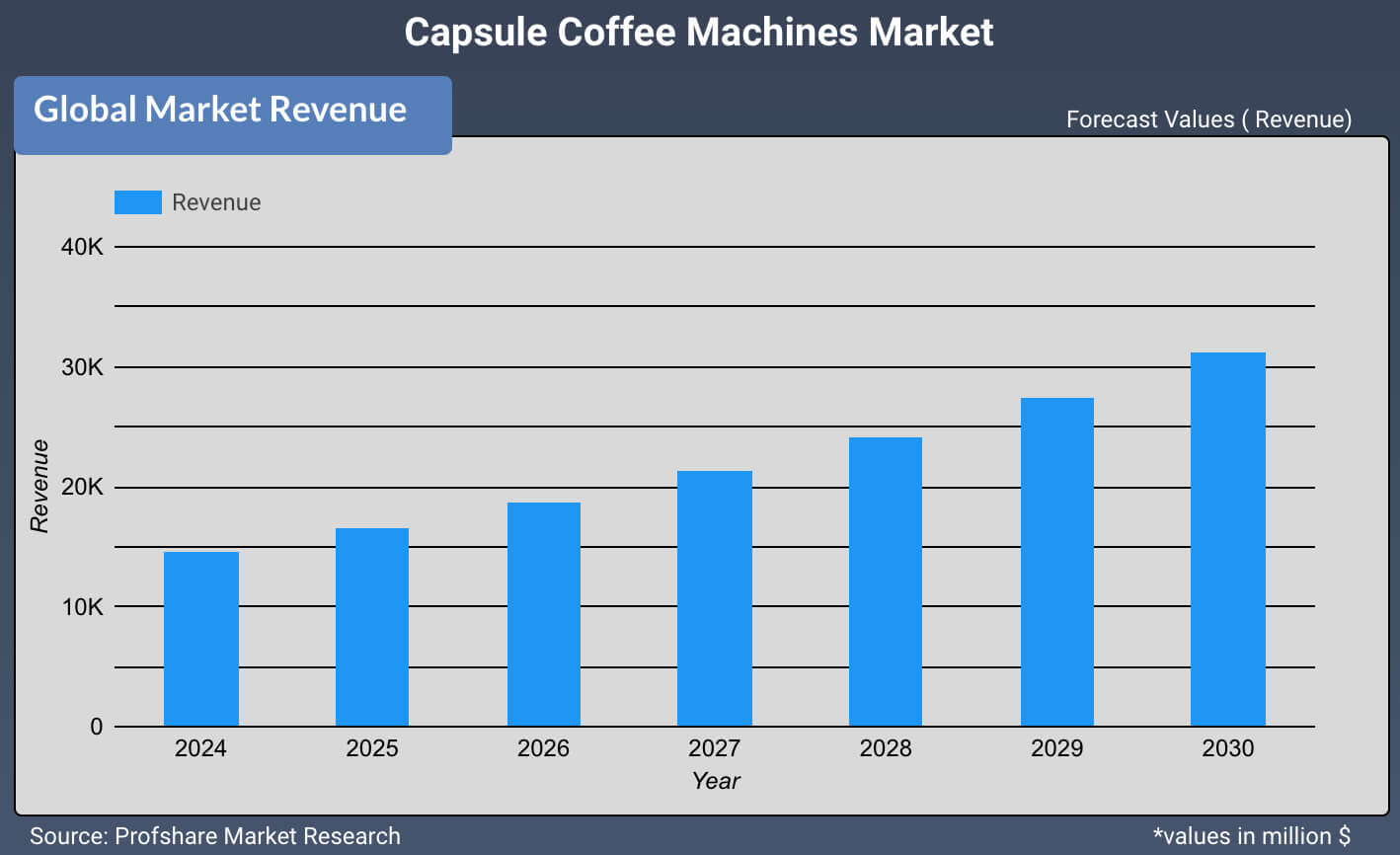
Increasing consumption of coffee in developing regions is major factor for growing capsule coffee machine market size. As of now, North America and Europe have significantly higher per capita coffee consumption. However, in recent few years, coffee consumption has significantly increased in Asia Pacific which is growing at an average of 4% especially in South East Asia where growing coffee consumption is nearly 13% of global coffee consumption. This will further increase to 16% by end of 2030. However, coffee consumption is slowly shifting towards single digit growth rate owing to industry saturation is a big concern for growth of this market.
New technological advancements in capsule coffee machine technology with new specifications, innovative concepts, and new applications are constantly evolving to provide improved quality, minimum components, and improved capacity with energy savings, and low maintenance cost which is boosting capsule coffee machine market during the forecast period globally. Capsule coffee machine industry is highly dominated with top 5 players accounting for over 90% of global capsule coffee machine market sales. This market will register double digit growth owing to increasing penetration in Asia Pacific during forecast period.
Capsule Coffee Machines Market : Product Type
- Closed Source System
- Open Source System
Capsule Coffee Machines Market : Application
- Household
- Commercial
Global Capsule Coffee Machines Market: Competitive Analysis
Report includes accurate analysis of key players with Market Value, Company profile, SWOT analysis. The Study consists of following key players in Global Capsule Coffee Machines Market:
- Nescafe
- Philips Senseo
- Keurig
- Tassimo
- illy
- Lavazza
- Dualit
- Eupa
- AAA
- Pacific Coffee
- Starbucks
Geographical analysis of Capsule Coffee Machines Market :
-
North America
- U.S.A
- Canada
- Europe
- France
- Germany
- Spain
- UK
- Rest of Europe
- Asia Pacific
- China
- Japan
- India
- South East Asia
- Latin America
- Brazil
- Middle East and Africa
Home, Kitchen & Household Goods Landscape
Report Coverage
| Parameter | Details |
|---|---|
| Base Year | 2025 |
| Historical Data | 2020 – 2025 |
| Forecast Period | 2026 – 2032 |
| Base Year Value | USD 12.88 Billion |
| Forecast Value | USD 31.26 Billion |
| CAGR | 13.5% |
| Regional Scope | North America · Europe · Asia-Pacific · Latin America · MEA · RoW |
Frequently Asked Questions
Capsule Coffee Machines Market was valued at USD 12.88 Billion in 2025 and is estimated to reach USD 31.26 Billion by 2032.
Capsule Coffee Machines Market is projected to grow at a CAGR of 13.5% during 2025–2032.
Capsule Coffee Machines Market? is dominated by the Closed Source System segment and the North America region holds the highest market share in 2025.
Some of the top key players in the Capsule Coffee Machines Market? are Nescafe, Philips Senseo, Keurig, Tassimo, illy, Lavazza, Dualit, Eupa, AAA, Pacific Coffee, Starbucks.
Primary driving factors for the growth of the Capsule Coffee Machines Market? include New technological advancements in capsule coffee machine technology with new specifications, innovative concepts, and new applications are constantly evolving to provide improved quality, minimum components, and improved capacity with energy savings, and low maintenance cost.
Yes. The report includes a dedicated section on geopolitical risk factors and their impact on supply chains, pricing, and regional demand dynamics.