
This report includes a dedicated chapter covering supply chain exposure, export controls, sanctions risk, and regulatory shifts affecting Automotive Position Sensor Market.
Automotive Position Sensor Market Strategic Outlook
Overview
The Automotive Position Sensor Market is witnessing steady expansion driven by increasing vehicle electrification, automation, and integration of advanced electronic systems. A position sensor is a device used to detect, measure, and record the physical movement or position of a component and convert it into electrical signals suitable for processing and control within automotive systems.
In modern vehicles, position sensors are critical for monitoring and managing multiple functions such as accelerator pedal positioning, brake pedal movement, seat adjustments, chassis alignment, steering systems, motor shaft rotation, and lighting control. These sensors enable precise system coordination, improving vehicle safety, performance, and driving comfort.
As vehicles continue to evolve into software-driven and electronically controlled systems, the demand for reliable and high-precision position sensing technologies is increasing. Automotive manufacturers are increasingly adopting these sensors to support advanced vehicle architectures, safety mechanisms, and intelligent mobility solutions.
Market Forecast 2026–2032
⬇ Download Chart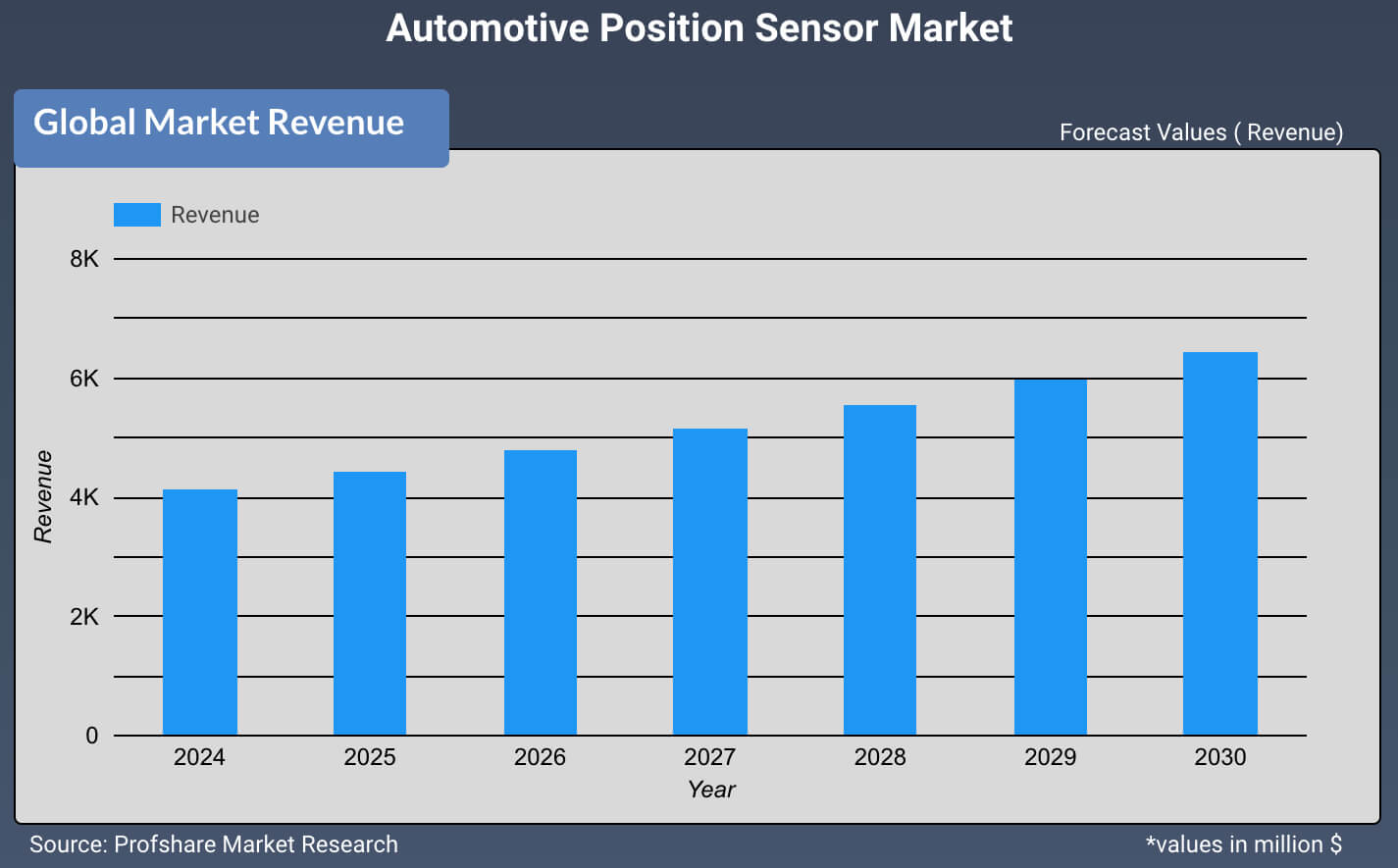
Market Drivers
The Automotive Position Sensor Market is primarily driven by the growth of the global automotive industry and the rising adoption of electronic components in vehicles. Increasing demand for driver safety, passenger comfort, and automated vehicle functionalities is encouraging manufacturers to integrate advanced sensor technologies across multiple vehicle systems.
Growing awareness regarding road safety and the rising number of road accidents are prompting the integration of position sensors in braking systems, steering mechanisms, and stability control systems. These sensors provide accurate feedback that helps enhance vehicle control and minimize risks associated with driving.
Additionally, the rapid adoption of emission control technologies and fuel-efficient vehicle systems is contributing to market growth. Position sensors play a key role in monitoring engine and powertrain components, enabling optimized performance and reduced environmental impact.
Emerging Trends
The adoption of Hall Effect sensors is a key trend shaping the Automotive Position Sensor Market. These sensors are widely used in crankshaft positioning, seat adjustment systems, and anti-lock braking systems due to their reliability, durability, and precision. Increasing integration of sensor-based systems in electric and hybrid vehicles is further accelerating demand.
Technological advancements in sensing technologies such as inductive, potentiometric, magnetoresistive, reed switch, electrolytic, and capacitive sensors are expanding the scope of automotive applications. Manufacturers are focusing on improving sensor accuracy, durability, and integration capabilities to meet evolving vehicle requirements.
The development of autonomous and connected vehicles is also influencing sensor innovation. Position sensors are becoming essential components in advanced driver assistance systems (ADAS), motion control systems, and intelligent vehicle architectures.
Segment Insights
By product type, the Automotive Position Sensor Market includes photoelectric, rotary, linear, and proximity sensors. Linear position sensors are expected to hold a significant share due to their extensive use in monitoring linear movement in throttle systems, braking components, and industrial automotive applications.
Rotary and proximity sensors are widely used in motion detection, steering control, and drivetrain applications, while photoelectric sensors are increasingly adopted in safety and automation systems. These diverse sensor types support multiple vehicle functions and contribute to enhanced performance and safety.
By vehicle type, the market is segmented into passenger cars and commercial vehicles. Passenger cars account for a major share due to higher production volumes and increasing integration of advanced electronic features. Commercial vehicles are also adopting position sensors for fleet safety, performance monitoring, and operational efficiency.
Regional Insights
North America represents a significant market for automotive position sensors due to high adoption of advanced vehicle technologies, increasing focus on automation, and strong presence of automotive manufacturers and technology providers. Electrification and autonomous driving initiatives are further supporting market growth in the region.
Asia Pacific is projected to witness rapid expansion driven by strong vehicle production, industrial growth, and rising demand for passenger and commercial vehicles in countries such as China, India, Japan, and South Korea. Increasing investments in automotive electronics are accelerating sensor adoption.
Europe also remains a key market supported by strict emission regulations, strong automotive innovation, and the presence of leading automotive OEMs focusing on advanced vehicle technologies and electrification.
Competitive Landscape
The Automotive Position Sensor Market is characterized by the presence of global automotive electronics manufacturers and sensor technology providers competing on innovation, product reliability, and technological advancements. Companies are investing heavily in research and development to enhance sensor precision, durability, and integration with advanced vehicle systems.
Strategic partnerships, product innovation, and geographic expansion are key strategies adopted by market participants. Manufacturers are focusing on developing next-generation sensor technologies to support electrified, autonomous, and connected vehicle platforms.
Key players operating in the market include ZF, NXP Semiconductors, Robert Bosch GmbH, Sensata Technologies, HELLA GmbH & Co. KGaA, CTS Corporation, Mitsubishi Electric Corporation, DENSO Corporation, and Continental AG. These companies are actively introducing new products and expanding their presence to strengthen competitive positioning.
The report provides detailed analysis, growth outlook, and forecasts for the Automotive Position Sensor Market at global and regional levels. The study includes market dynamics such as drivers, restraints, opportunities, and challenges influencing industry growth.
The research further covers value chain analysis, technological developments, supplier landscape, and competitive strategies shaping the market. These insights enable stakeholders to understand emerging opportunities and make informed strategic decisions during the forecast period.
Automotive Components Landscape
Report Coverage
| Parameter | Details |
|---|---|
| Base Year | 2025 |
| Historical Data | 2020 – 2025 |
| Forecast Period | 2026 – 2032 |
| Base Year Value | USD 3.84 Billion |
| Forecast Value | USD 6.46 Billion |
| CAGR | 7.7% |
| Regional Scope | North America · Europe · Asia-Pacific · Latin America · MEA · RoW |
Frequently Asked Questions
Automotive Position Sensor Market was valued at USD 3.84 Billion in 2025 and is estimated to reach USD 6.46 Billion by 2032.
Automotive Position Sensor Market is projected to grow at a CAGR of 7.7% during 2025–2032.
Automotive Position Sensor Market is dominated by the Passenger Cars segment and the North America region holds the highest market share in 2025.
Some of the top key players in the Automotive Position Sensor Market are Bosch, Continental, Denso, TE Connectivity, Infineon Technologies, Sensata Technologies, NXP Semiconductors, Hella.
Primary driving factors for the growth of the Automotive Position Sensor Market include Increasing road accidents are leading to rising concern regarding driver as well as passenger safety along with continuous developments in electronic sensor applications in automobiles and Rising environmental and health concerns.
Yes. The report includes a dedicated section on geopolitical risk factors and their impact on supply chains, pricing, and regional demand dynamics.