
This report includes a dedicated chapter covering supply chain exposure, export controls, sanctions risk, and regulatory shifts affecting Automotive Electronic Control Unit (ECU) Market.
Automotive Electronic Control Unit (ECU) Market Strategic Outlook
Overview
Automotive Electronic Control Units (ECUs) are integrated computer systems responsible for managing and controlling electrical, electronic, and mechanical functions in modern vehicles. From regulating engine performance and fuel efficiency to controlling safety systems and infotainment features, ECUs play a central role in vehicle intelligence and functionality.
An ECU consists of embedded microcontrollers, sensors, actuators, and software that monitor vehicle operations, process data, and enable real-time decision-making. Modern vehicles rely on multiple ECUs to manage systems such as powertrain, braking, suspension, body electronics, infotainment, and battery management. Some advanced vehicle models today incorporate more than 80 ECUs to support connected, automated, and electrified functionalities.
Role in Vehicle Ecosystem
Electronic control units (ECUs) act as the central intelligence layer of modern vehicles, coordinating mechanical, electrical, and digital systems in real time.
- Integrates with vehicle electrical architecture and wiring harness networks.
- Processes inputs from automotive sensors and ADAS platforms.
- Controls powertrain, braking, and thermal management systems.
- Supports infotainment, cockpit electronics, and connectivity platforms.
- Enables software-defined vehicle functionality and system automation.
ECUs operate as core system controllers that connect safety, performance, and user-experience technologies across the broader vehicle ecosystem.
Market Forecast 2026–2032
⬇ Download Chart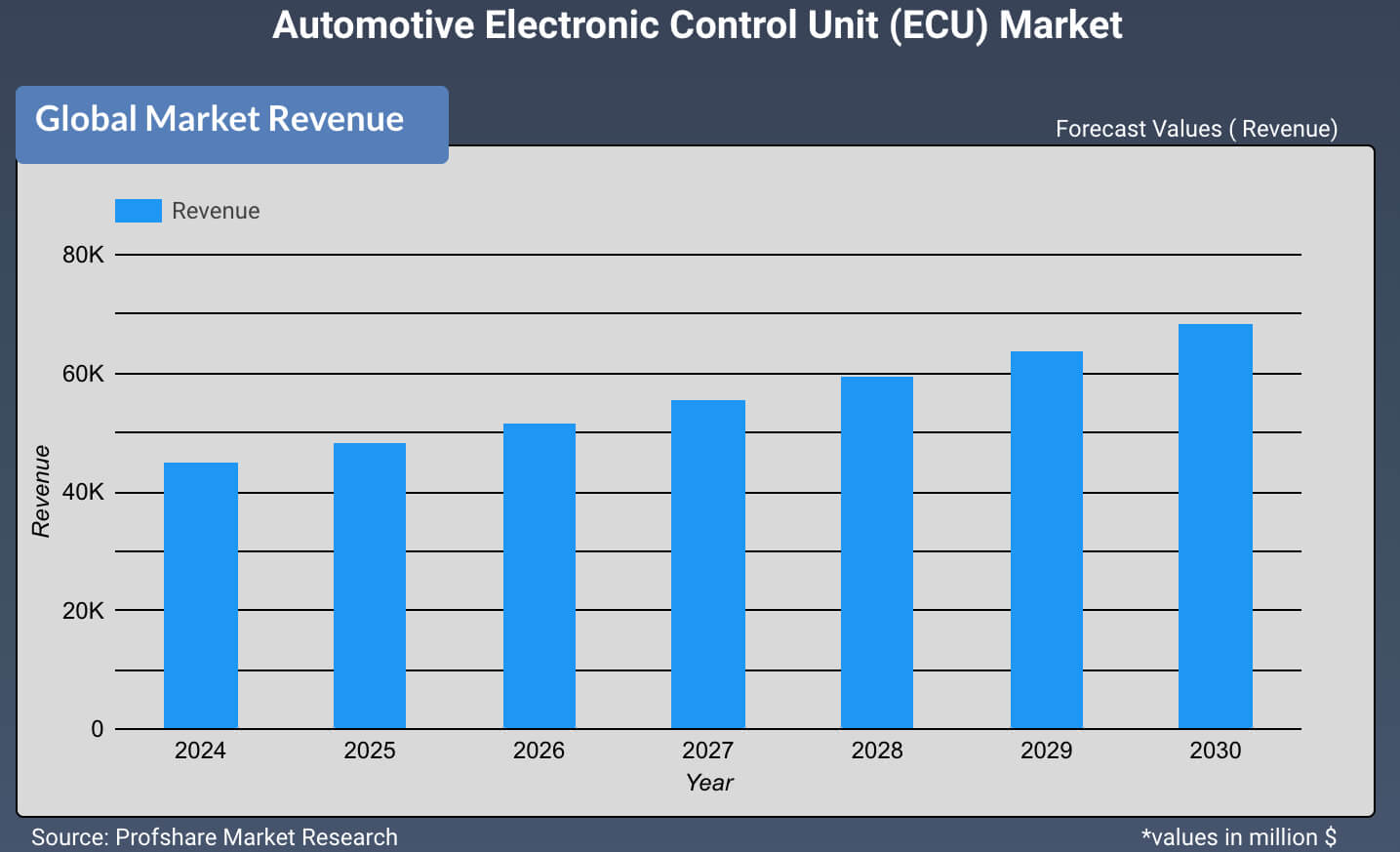
Market Drivers
The automotive ECU market is experiencing strong growth due to rapid vehicle electrification and increasing integration of electronic systems. Rising adoption of hybrid and electric vehicles, along with growing demand for advanced driver assistance systems (ADAS), connected car technologies, and intelligent safety features, is significantly expanding ECU deployment across vehicle platforms.
Government regulations focused on fuel efficiency, emission reduction, and vehicle safety are further accelerating ECU adoption. Additionally, increasing consumer demand for premium, technologically advanced vehicles is encouraging automakers to integrate sophisticated control systems to enhance driving experience and operational efficiency.
Emerging Trends
The shift toward connected and software-defined vehicles is transforming ECU architecture. Integration with smartphones and cloud platforms enables real-time vehicle diagnostics, performance monitoring, and predictive maintenance. Advanced ECU systems supporting ADAS, autonomous driving, and over-the-air (OTA) software updates are becoming key development areas.
Electrification trends are also increasing demand for specialized ECUs such as battery management systems (BMS), energy control modules, and power electronics controllers, particularly in electric and hybrid vehicles.
Segment Insights
By product type, the market includes ADAS & safety systems, chassis electronics, infotainment systems, and powertrain control units. ADAS and safety systems are expected to witness significant growth due to rising adoption of autonomous and semi-autonomous technologies.
By vehicle type, passenger cars account for the largest share due to higher integration of electronic features and comfort technologies. Commercial vehicles are also witnessing increased ECU deployment driven by telematics, fleet management, and safety requirements.
Regional Insights
North America represents a significant market for automotive ECUs due to strong demand for premium vehicles, connected technologies, and electric mobility solutions. The presence of major automotive manufacturers and technology providers further supports regional growth.
Asia Pacific is expected to witness rapid expansion, supported by large-scale vehicle production, increasing consumer spending, and rising adoption of advanced automotive technologies in countries such as China, India, Japan, and South Korea.
Europe also remains a key region due to stringent emission regulations, strong EV adoption, and innovation in automotive electronics.
Competitive Landscape
The automotive ECU market is highly competitive, with global Tier-1 suppliers and technology companies focusing on product innovation, software integration, and partnerships with OEMs. Companies are investing heavily in R&D to develop advanced control systems for electrified, connected, and autonomous vehicles.
Key players are emphasizing cost optimization, modular ECU architectures, and high-performance computing solutions to support next-generation vehicle platforms. Strategic collaborations and long-term supply agreements with automakers remain critical for maintaining market position.
The study covers a detailed analysis, growth and forecast of the Automotive Electronic Control Unit (ECU) Market. The report includes market analysis on global and regional level. The study covers historical data analysis from 2020 and 2025 and market forecast for 2026 and 2032 based on revenue generated. The study includes market value in terms of revenue in million USD for years 2018-2030 and compound annual growth rate (CAGR) in % from 2026 and 2032. The market is expected to show constant growth between 2026 and 2032.
The report provides Automotive Electronic Control Unit (ECU) Market Dynamics, includes industry growth drivers, challenges, opportunities, risk, constraints as well as threats. Report also includes Manufacturing Cost Analysis mainly included Raw Materials Analysis, Price Trend of product, Mergers & Acquisitions, Expansion, Key Suppliers of product, Concentration Rate of Automotive Electronic Control Unit (ECU) Market, Manufacturing Process Analysis. Research Report contains Market Effect Factors analysis mainly included Technology Progress, Consumer Needs Trend, External Environmental Change.
Automotive Electronic Control Unit (ECU) Market: Product Type
- ADAS & Safety System
- Chassis Electronics
- Infotainment
- Power Train
Automotive Electronic Control Unit (ECU) Market: Application
- Passenger Cars
- Commercial Vehicles
Automotive Electronic Control Unit (ECU) Market: Competitive Analysis
Report includes accurate analysis of key players with Market Value, Company profile, SWOT analysis. The Study consists of following key players in Automotive Electronic Control Unit (ECU) Market:
- Delphi Technologies
- Continental AG
- Denso Corporation
- ZF Friedrichshafen
- Robert Bosch GmbH
Geographical analysis of Automotive Electronic Control Unit (ECU) Market:
-
North America
- U.S.A.
- Canada
- Europe
- France
- Germany
- Spain
- UK
- Rest of Europe
- Asia Pacific
- China
- Japan
- India
- South East Asia
- Latin America
- Brazil
- Middle East and Africa
Automotive Manufacturing and Supply Chain Markets Landscape
Report Coverage
| Parameter | Details |
|---|---|
| Base Year | 2026 |
| Historical Data | 2020 – 2025 |
| Forecast Period | 2026 – 2032 |
| Base Year Value | USD 42.08 Billion |
| Forecast Value | USD 68.46 Billion |
| CAGR | 7.2% |
| Regional Scope | North America · Europe · Asia-Pacific · Latin America · MEA · RoW |
Frequently Asked Questions
Automotive Electronic Control Unit (ECU) Market was valued at USD 42.08 Billion in 2026 and is estimated to reach USD 68.46 Billion by 2032.
Automotive Electronic Control Unit (ECU) Market is projected to grow at a CAGR of 7.2% during 2026–2032, driven by rising demand across industrial and specialty applications.
Automotive Electronic Control Unit (ECU) Market is dominated by the ADAS & Safety System segment and the Asia-Pacific region holds the highest market share in 2025.
Some of the top key players in the Automotive Electronic Control Unit (ECU) Market are Bosch, Continental, Denso, Delphi Technologies, Hitachi Astemo, Valeo, Magneti Marelli, Hyundai Mobis.
Primary driving factors for the growth of the Automotive Electronic Control Unit (ECU) Market include Ease of driving, driver safety, security concerns, low maintenance demanded by the customers along with Technological advancements in automotive industry.
Yes. The report includes a dedicated section on geopolitical risk factors and their impact on supply chains, pricing, and regional demand dynamics.