
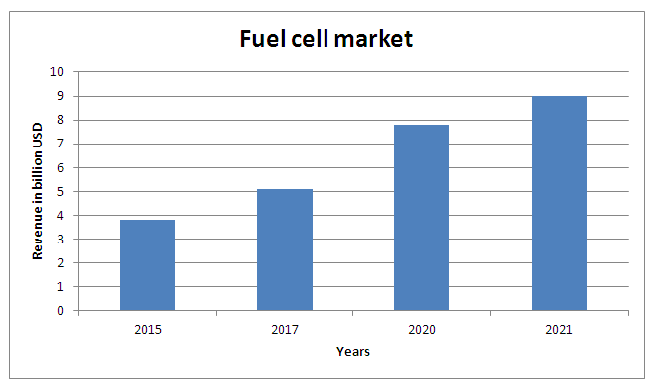
Global fuel cell Market was valued at USD 3.83 billion in 2015 and application is expected to reach a market size of $8.99 billion by 2021, with a CAGR of 15.28 % between 2015 and 2021.
March, 2019 | Publisher: Profshare Market Research
Global fuel cell market was valued at USD 3.83 billion in 2015 and application is expected to reach a market size of $8.99 billion by 2021, with a CAGR of 15.28 % between 2015 and 2021.
The global fuel cell Market was valued at USD 3.83 billion in 2015 and application is expected to reach a market size of $8.99 billion by 2021, with a CAGR of 15.28 % between 2015 and 2021.Favorable government regulations, ability to cut down emission rates and capability to make use of domestic sources of energy such as natural gas are some of the key factors likely to drive the demand for hydrogen power plants during coming eight years. The application of fuel cells is growing rapidly in the stationary segment because of their smaller size and ability to run on various fuels.
A fuel cell is a device that generates electric energy through electrochemical reactions between an oxidizing agent and a fuel – a material that stores energy in chemical form. Both species are not stored in the fuel cell but must be supplied from external sources.A single fuel cell consists of an electrolyte sandwiched between two electrodes. Bipolar plates on either side of the cell help distribute gases and serve as current collectors.A fuel cell stack may contain a few to hundreds of individual fuel cells layered together but that depends on applications. This “scalability” makes fuel cells ideal for a wide variety of applications, such as stationary power stations, portable devices, and transportation.
Asia-Pacific is estimated as one of the largest fuel generating region, with Japan and South Korea being the major countries driving the market. The demand for fuel cells is also increasing rapidly in regions like Europe and North America. In ROW, the market is growing at a slower rate due to lesser awareness, although these regions comprise the future markets for fuel cells along with, some regions in Asia-Pacific.In 2014, the fuel cell industry grew by almost $1 billion, reaching $2.2 billion in sales, up from $1.3 billion in 2013. Major Rise in fuel cells were seen in North America and Asia Pacific revenues, spurred by fuel cells for material handling (U.S.) and large-scale stationary sales by U.S. companies and residential fuel cells in Japan.
There are three main markets for fuel cell technology: stationary power, transportation, and portable power. All the application in which the fuel cells are operated at a fixed location for primary power, backup power, or combined heat and power (CHP) comes under Stationary power. Transportation applications include motive power for passenger cars, buses and other fuel cell electric vehicles (FCEVs), specialty vehicles, material handling equipment (MHE), and auxiliary power units (APUs) for off-road vehicles.
There are many types of fuel cells currently in operation in a wide range of applications, including molten carbonate fuel cells (MCFC), solid oxide fuel cells (SOFC), phosphoric acid fuel cells (PAFC), direct methanol fuel cells (DMFC) and low and high temperature proton exchange membrane (PEM) fuel cells.The fuel cell industry is highly consolidated with the top five companies accounting for over 80% of industry demand. Hydrogen energy is expected to maintain a strong position in the industry owing to continuous drive on product development and increasing research and development expenditure.
Key market players will focus on mergers & acquisition, business re-organization, and strategic alliances to expand the end user product offering in different industries. Companies such as Toyota, Honda, General Motors, and Samsung are some of the leading companies with the highest number of fuel cell patents.Other notable players in the industry include Plug power, Ballard Power Systems, Hydrogenics Corporation, Ceramic Fuel Cells, Ltd., SFC Energy AG, etc.
Connect With Us
- Toll Free: 1-855-547-3687
- Email: [email protected]