
This report includes a dedicated chapter covering supply chain exposure, export controls, sanctions risk, and regulatory shifts affecting Cardiac Arrhythmia Monitoring Device Market.
Cardiac Arrhythmia Monitoring Device Market Strategic Outlook
Cardiac Arrhythmia Monitoring Devices are mostly used in disorders like cardiac arrhythmia, continuous cardiac monitoring is essential as cardiac arrhythmia is not fully curable. So it’s not practical to retain patient in hospital for extremely long durations nor its practical to ask patient to visit hospital on daily basis. So these Cardiac Arrhythmia Monitoring Devices are the best way to continuously monitor the patient who suffering from cardiac arrhythmia is through remote patient monitoring by using arrhythmia monitoring Devices. In technical terms it referred as telecardiology, in this Cardiac arrhythmia monitoring device provided to the patient suffering from cardiac arrhythmia. These devices fixed on the chest area of patient of patients superficially.
Market Forecast 2026–2032
⬇ Download Chart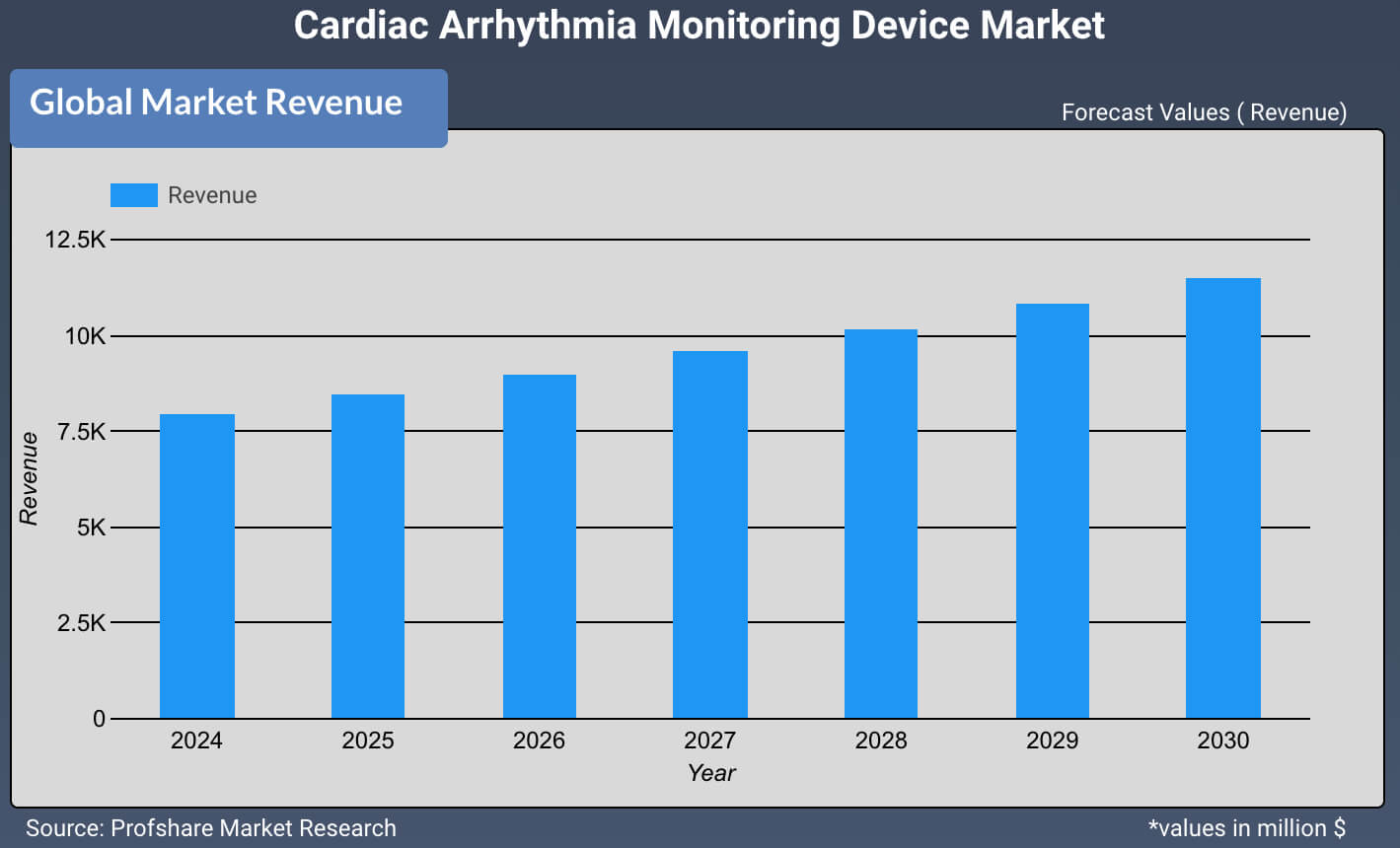
Cardiac Arrhythmia Monitoring devices mainly segmented on the basis of product type into ECG Devices, Implantable Loop Recorder, Cardiac Output Monitoring, Event Monitors, Holter Monitors. ECG (Electrocardiagram) is the most important monitoring device for the test in the investigation of heart-related problem. With the help of these devices doctor understand the possible role of the heart in a person symptoms. Implantable loop Recorder used in those cases where it’s difficult to detect through ECG or 24 hour monitoring such as syncope. Holter Monitor used to test the wires that are connected to a smaller, portable device which ultimately attached to the chest. After the specified time period the monitor can be returned to your doctor to see whether any arrhythmias have been indicated.
Cardiac Arrhythmia Monitoring devices are widely applicable in Atrial Fibrillati, Bradycardia, Conduction Disorders, Premature Contraction, Tachycardia, Ventricular Fibrillation, rdcs. Remote monitoring of implantable cardiac defibrillators (ICD’s) and pacemakers is commonly utilized in current practice but there is emerging interest into use of remote atrial tachycardia (AT) monitoring for tailored anti-coagulation in patients with atrial fibrillation. The recently released data from the IMPACT trial randomized participants to device-tailored anticoagulation based on AT alerts from existing ICD’s or pacemakers vs. conventional office-based monitoring. Cardiac tests like electrocardiograms allows doctors to monitor hearts activity at rest and at one point in time. If heart has some problem then it rhythms and cardiac symptoms can be seen on irregular interval. Event monitor finds its main purpose in recording heart rate and rhythm during a cardiac symptoms. Event monitor works only when a person starts the device.
Global cardiac arrhythmia monitoring devices are segmented on the basis of geography into Latin America, North America, Europe, Asia Pacific and Middle East and Africa. North America is largest market share holder in cardiac arrhythmia monitoring devices market. However, the Asia-Pacific region is expected to grow at the highest CAGR during forecast period owing to high demand from developing economies such as China, India and Japan. United States is the largest manufacturer and consumer of Cardiac Arrhythmia Monitoring devices market in the world with Europe also play important roles in global Cardiac Arrhythmia Monitoring devices market while China is fastest growing region. New advancements in technology, high R&D investment by the global players, rising demand for automation and integration of multiple processes in Cardiac Arrhythmia Monitoring devices, Main key players in Cardiac arrhythmia monitoring devices are Baxter, Hospira, Abbott, Astra Zenec, Roche, Novartis, Pfizer, Eisai, Fresenius Se & Co., Hikma Pharmaceuticals.
Cardiac Arrhythmia Monitoring Device Market : Product Type
- ECG Devices
- Implantable Loop Recorder
- Cardiac Output Monitoring
- Event Monitors
- Holter Monitors
Cardiac Arrhythmia Monitoring Device Market : Application
- Atrial Fibrillation
- Bradycardia
- Conduction Disorders
- Premature Contraction
- Tachycardia
- Ventricular Fibrillation
Global Cardiac Arrhythmia Monitoring Device Market: Competitive Analysis
Report includes accurate analysis of key players with Market Value, Company profile, SWOT analysis. The Study consists of following key players in Global Cardiac Arrhythmia Monitoring Device Market:
- Baxter
- Hospira
- abbott
- Astra Zeneca
- Roche
- Novartis
- Pfizer
- Eisai
- Fresenius Se & Co.
- Hikma Pharmaceuticals
Geographical analysis of Cardiac Arrhythmia Monitoring Device Market:
-
North America
- U.S.A
- Canada
- Europe
- France
- Germany
- Spain
- UK
- Rest of Europe
- Asia Pacific
- China
- Japan
- India
- South East Asia
- Latin America
- Brazil
- Middle East and Africa
Patient Monitoring Devices Landscape
Report Coverage
| Parameter | Details |
|---|---|
| Base Year | 2025 |
| Historical Data | 2020 – 2025 |
| Forecast Period | 2026 – 2032 |
| Base Year Value | USD 7.52 Billion |
| Forecast Value | USD 11.53 Billion |
| CAGR | 6.3% |
| Regional Scope | North America · Europe · Asia-Pacific · Latin America · MEA · RoW |
Frequently Asked Questions
Cardiac Arrhythmia Monitoring Device Market was valued at USD 7.52 Billion in 2025 and is estimated to reach USD 11.53 Billion by 2032.
Cardiac Arrhythmia Monitoring Device Market is projected to grow at a CAGR of 6.3% during 2025–2032.
Cardiac Arrhythmia Monitoring Device Market is dominated by the ECG Devices segment and the North America region holds the highest market share in 2025.
Some of the top key players in the Cardiac Arrhythmia Monitoring Device Market are Medtronic, Abbott, Boston Scientific, GE HealthCare, Philips Healthcare, iRhythm Technologies, Biotronik, Nihon Kohden.
Primary driving factors for the growth of the Cardiac Arrhythmia Monitoring Device Market include New advancements in technology, high R&D investment by the global players, rising demand for automation and integration of multiple processes.
Yes. The report includes a dedicated section on geopolitical risk factors and their impact on supply chains, pricing, and regional demand dynamics.