
Automotive Fuse Market Overview
The Automotive Fuse Market was valued at USD 11.07 Billion in 2025 and is projected to reach USD 20.18 Billion by 2032, growing at a CAGR of 6.9% during 2026–2032, with North America holding the largest share.
Primary Drivers
- Rapid growth in vehicle electrical content - infotainment, ADAS, power seats, telematics and 48V architectures - is multiplying the number of protected circuits and fuses per vehicle.
- EV and hybrid adoption is driving demand for high-voltage and high-rupture-capacity fuses (including pyro/pyrotechnic fuses) rated for battery, inverter and charging circuits.
- Tightening vehicle electrical-safety and functional-safety regulations, together with rising global vehicle production and aftermarket replacement cycles, sustain steady volume growth.
Primary Challenges
- Severe price pressure and commoditisation in conventional blade fuses, with low differentiation and strong low-cost competition compressing margins.
- Growing adoption of solid-state/semiconductor fuses, smart power distribution and eFuse architectures threatens to displace traditional fuse volumes over time.
- Copper, zinc and silver price volatility plus stringent OEM qualification, AEC-Q and functional-safety testing raise cost and lengthen design-in cycles.
This report includes a dedicated chapter covering supply chain exposure, export controls, sanctions risk, and regulatory shifts affecting Automotive Fuse Market.
Automotive Fuse Market Strategic Outlook
Automotive fuses are a class of fuses used to protect the wiring and electrical equipment inside a vehicle. They are generally designed for circuits not higher than 32 volts direct current, but some types are designed for 42-volt electrical systems. Automotive fuses are also used in non-automotive electrical products. Automotive fuses are classified as Blade fuses (also called spade or plug-in fuses), Bosch type, Lucas type, Glass tube type, and Limiter type.
Growth trajectory, 2026–2032
How this market is covered
Revenue by end use
Global Automotive Fuse Market is expected to grow at a CAGR of 6.9 %. Increase in vehicle production is primary reason for growth of Automotive Fuse Market. Rise in disposable income, population, urbanisation, development in road transportation services are also propelling fuel in the growth of Automotive Fuse Market. Technological advancement in Automotive Fuse market includes advancements in both chip and wire-in-air fuse technology is offering dramatically better reliability results over traditional solutions. Multi-layer Ceramic Chip Fuse has a wider operating temperature and can maintain stable operating characteristics in extreme conditions. AirMatrix Fuse offers reliable operation in high-stress automotive applications.
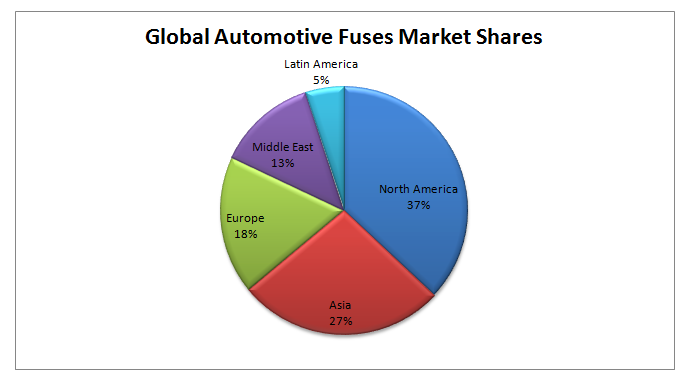
North America (USA and Canada) contributes 37% of overall Automotive Fuse Market.Largest number of vehicle manufactures and user is key factor for highest demand for Automotive Fuse in North America. Developing countries like China and India in Asia pacific region with highest population count shares 27% of overall Market.Europe, Middle east and Latin America contributes 18%,13% and 5% resp. in Global Automotive Fuse Market.
Automotive Fuse Market : Fuse Type
- Blade Fuses
- Cartridge Fuses
- High Current Fuses
- High Voltage Fuses
Automotive Fuse Market : Application
- Passenger Cars
- Light Commercial Vehicle
- Heavy Commercial Vehicle
- SUVs
Global Automotive Fuse Market : Competitive Analysis
Report includes accurate analysis of key players with Market Value, Company profile, SWOT analysis. The Study consists of following key players in Global Automotive Fuse Market:
- Littelfuse
- Eaton
- PEC
- Tamura
- MTA
- Hansor Polymer Technology
- ESKA
- AURORA Co., Ltd.
- Selittel Fuses
- Hongda Electronic Technology
- Vicfuse
- Dong Guan Andu Electronics
- Uchi
- OptiFuse
- Zhenhui Electronics
- FBELE company
Geographical analysis of Automotive Fuse Market :
-
North America
- U.S.A
- Canada
- Europe
- France
- Germany
- Spain
- UK
- Rest of Europe
- Asia Pacific
- China
- Japan
- India
- South East Asia
- Latin America
- Brazil
- Middle East and Africa
Automotive Components Landscape
Report Coverage
| Parameter | Details |
|---|---|
| Base Year | 2025 |
| Historical Data | 2020 – 2025 |
| Forecast Period | 2026 – 2032 |
| Base Year Value | USD 11.07 Billion |
| Forecast Value | USD 20.18 Billion |
| CAGR | 6.9% |
| Regional Scope | North America · Europe · Asia-Pacific · Latin America · MEA · RoW |
Frequently Asked Questions
Automotive Fuse Market was valued at USD 11.07 Billion in 2025 and is estimated to reach USD 20.18 Billion by 2032.
Automotive Fuse Market is projected to grow at a CAGR of 6.9% during 2025–2032.
North America (USA and Canada) contributes 37% of overall Automotive Fuse Market.
Some of the top key players of the Automotive Fuses Market are Littelfuse,Eaton,PEC,Tamura,MTA,Hansor Polymer Technology,ESKA,AURORA Co., Ltd.,Selittel Fuses,Hongda Electronic Technology,Vicfuse,Dong Guan Andu Electronics,Uchi,OptiFuse,Zhenhui Electronics,FBELE company
1. Rapid growth in vehicle electrical content - infotainment, ADAS, power seats, telematics and 48V architectures - is multiplying the number of protected circuits and fuses per vehicle. 2. EV and hybrid adoption is driving demand for high-voltage and high-rupture-capacity fuses (including pyro/pyrotechnic fuses) rated for battery, inverter and charging circuits. 3. Tightening vehicle electrical-safety and functional-safety regulations, together with rising global vehicle production and aftermarket replacement cycles, sustain steady volume growth.
Yes. The report includes a dedicated section on geopolitical risk factors and their impact on supply chains, pricing, and regional demand dynamics.